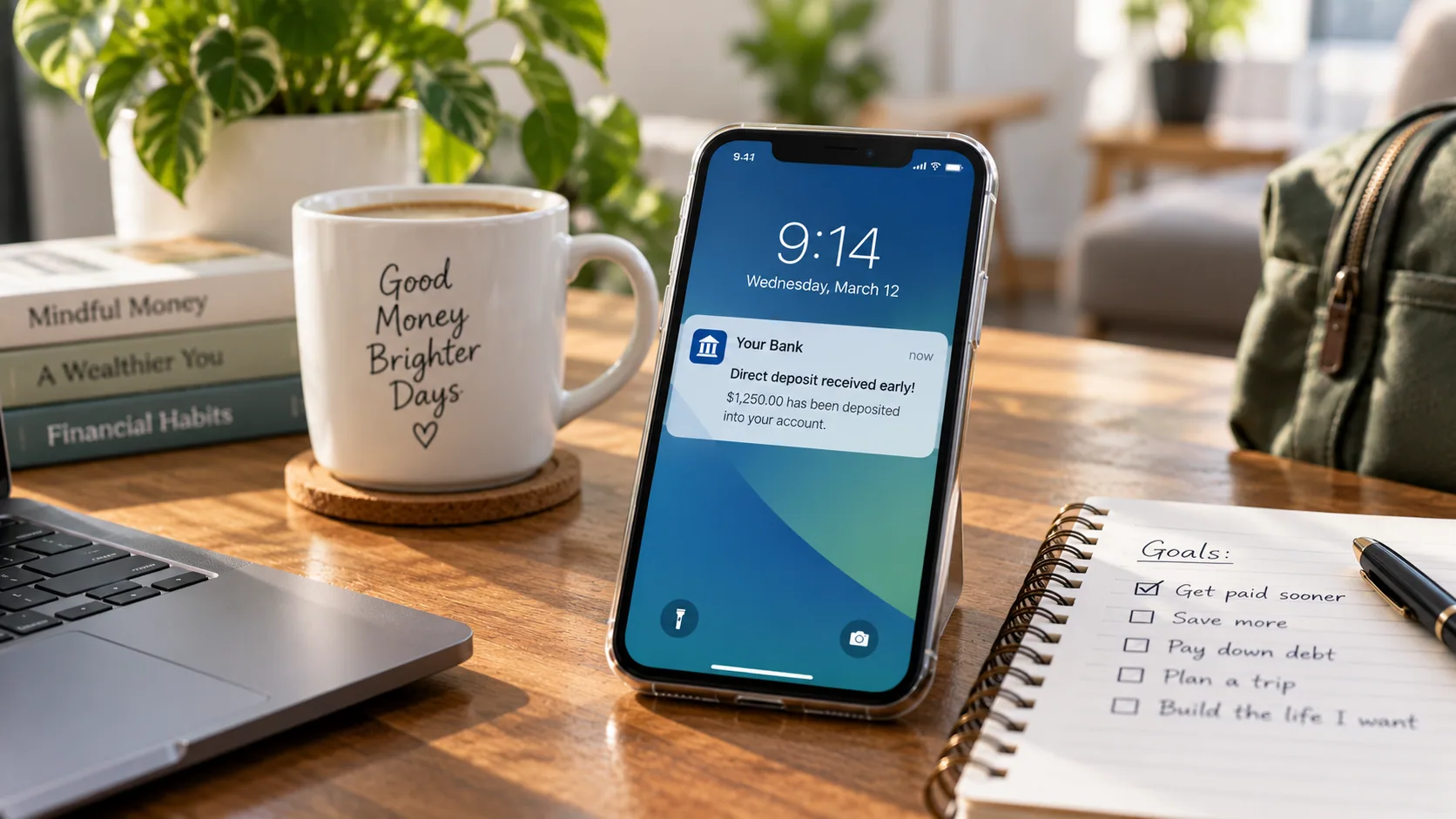
Banks with early direct deposit can make eligible payroll funds available before an employer's scheduled payday. Many participating banks advertise access as early as two days ahead, giving customers additional time to pay bills, move money to savings, or manage everyday expenses.
Early paycheck access does not mean your employer changes your official payday, and it does not increase the amount you receive. Banks generally make qualifying ACH deposits available after receiving payment information from the payer before the scheduled settlement date.
Timing can vary. Capital One, Chase, Wells Fargo, and other institutions state that early availability depends partly on when the employer or other payer submits the payment information. A deposit could arrive two days early, one day early, or on the scheduled date.
Several large banks currently provide the feature through eligible checking accounts. Here are some options worth comparing.
Banks With Early Direct Deposit Compared
| Bank | Account | Potential Early Access | Monthly Fee |
|---|---|---|---|
| Capital One | 360 Checking | Up to 2 days | $0 |
| Chase | Secure Banking | Up to 2 business days | $4.95 or $0 |
| Ally Bank | Spending Account | Up to 2 days | $0 monthly maintenance fee |
| Wells Fargo | Eligible checking accounts | Up to 2 business days | Varies by account |
| Fifth Third Bank | Momentum Checking | Up to 2 days | $0 |
| Regions Bank | LifeGreen Checking | Up to 2 days | $0, $8, or $11 |
The early-pay feature itself generally does not carry a separate charge at the institutions covered below, though the underlying account may have monthly or transaction fees.
Capital One 360 Checking
Capital One is one of the major banks that pay early through its Early Paycheck feature.
Customers with 360 Checking can receive qualifying electronic deposits up to two days before the scheduled payment date after setting up direct deposit.
Capital One says eligible deposits generally include recurring payments such as:
- salary;
- pensions; and
- government benefits.
Certain non-payroll and tax payments do not qualify. Eligibility can also vary from one pay period to another because availability depends on when Capital One receives instructions from the payer.
Capital One 360 Checking Features
360 Checking currently has:
- no monthly account fee;
- no minimum balance requirement;
- no overdraft fees;
- early paycheck access at no added charge; and
- access to Capital One's participating fee-free ATM networks.
Capital One says direct deposit setup may take up to two pay cycles to become effective.
For customers searching for checking accounts with early direct deposit, 360 Checking provides early paycheck access without adding a monthly maintenance fee.
Chase Secure Banking
Chase Secure Banking provides qualifying direct deposits up to two business days early.
Chase states that eligible transactions include certain ACH credits such as payroll, government benefits, and similar payments. Customers who already have qualifying direct deposit are automatically eligible for the early-access feature.
The exact timing depends on when the payer submits the information to Chase. As a result, customers may not receive their funds early during every pay cycle.
Chase Secure Banking Fees
The account currently carries a $4.95 monthly service fee, though Chase provides two ways to reduce it to $0 during a monthly statement period:
- receive at least $250 in qualifying electronic deposits; or
- have an account owner between ages 17 and 24.
Secure Banking also has no overdraft fees and requires no minimum opening deposit.
Chase may appeal to people who want early access to qualifying pay alongside physical branch and ATM access.
Ally Bank Spending Account
Ally Bank includes early direct deposit with its Spending Account.
Once an eligible direct deposit is established, customers may get paid up to two days early without separately enrolling in the feature.
Ally states that the timing depends on when it receives information from the payer. A deposit therefore may not arrive ahead of schedule every time.
Ally Spending Account Features
The Spending Account includes:
- no monthly maintenance fee;
- no minimum balance requirement;
- no overdraft fees;
- eligible early direct deposits; and
- access to Ally's participating ATM networks.
Ally can work well for customers who are comfortable with online banking and do not regularly need traditional branch services.
Its early-pay feature is tied specifically to eligible deposits into an Ally Spending Account rather than every transaction entering the account.
Wells Fargo Early Pay Day
Wells Fargo calls its feature Early Pay Day.
Customers with eligible direct deposits may receive qualifying funds up to two business days early. There is no separate enrollment requirement once an eligible direct deposit has been established.
Wells Fargo states that Early Pay Day can apply to qualifying payments such as payroll, pensions, and certain government benefits.
Early availability is not guaranteed for every deposit.
Why Wells Fargo May Fit Some Customers
Wells Fargo combines the early-pay feature with access to traditional branches, ATMs, online banking, and mobile tools.
That can make it worth comparing with online-only early paycheck banks if in-person banking matters to you.
Monthly charges vary depending on the checking account chosen, so review the current fee schedule before opening an account.
Fifth Third Momentum Checking
Fifth Third Momentum Checking provides Early Pay for qualifying direct deposits.
Fifth Third states that customers may receive employer direct deposits up to two days before their scheduled payday without paying an additional Early Pay fee.
Momentum Checking currently has:
- no monthly fee;
- no minimum balance requirement;
- no minimum opening deposit; and
- Early Pay for qualifying direct deposits.
Direct deposit still needs to be established through the employer or other eligible payer.
Fifth Third may be worth comparing if you live within its service area and want traditional banking access paired with early payroll availability.
Regions LifeGreen Checking
Regions Bank provides Early Pay through LifeGreen Checking and several other eligible accounts.
Customers with qualifying direct deposit may receive paychecks or regular government payments up to two days before the scheduled payment date. Regions states that no separate enrollment is required and no additional Early Pay fee applies.
Regions LifeGreen Checking Fees
LifeGreen Checking currently costs:
- $8 per month with online statements; or
- $11 per month with paper statements.
Regions waives the monthly fee when customers meet one of its qualifying conditions, including:
- maintaining a $1,500 average monthly balance;
- receiving one qualifying ACH direct deposit of at least $500; or
- receiving qualifying ACH direct deposits totaling at least $1,000.
A $25 minimum opening deposit currently applies.
Regions may suit customers who value branch banking and want access to qualifying income before the scheduled payment date.
How Early Direct Deposit Works
To understand banks with early direct deposit, it helps to know what happens before payday.
Employers commonly send payroll through the Automated Clearing House, or ACH, network.
The payroll instruction includes information about:
- the recipient;
- the account;
- the payment amount; and
- the scheduled payment date.
Banks can sometimes receive information about the incoming deposit before that date.
Some institutions choose to make qualifying funds available when they receive that advance payment information instead of holding the deposit until the scheduled payday.
That creates the early-pay window.
Early Deposit Does Not Change Your Pay Schedule
If your official payday is Friday and the bank makes your paycheck available Wednesday, your employer still considers Friday the scheduled payday.
You are accessing the same paycheck earlier.
After the first early deposit, the pay cycle usually remains essentially the same length.
For instance, if eligible deposits repeatedly become available every other Wednesday instead of every other Friday, you are still being paid approximately every two weeks.
Early access changes timing rather than the amount or frequency of your income.
Why Paychecks May Not Always Arrive Early
Banks repeatedly use the phrase “up to” when advertising early deposit for a reason.
Capital One says availability depends on the timing of the payer's instructions and can vary between payment periods.
Chase similarly says the crediting date depends on when the payer submits information, meaning customers may not receive their money early every time.
Wells Fargo describes its feature as access up to two business days early, rather than guaranteeing a specific early-arrival date.
This means you should generally avoid scheduling essential bills solely around an expected early deposit until the funds actually appear in your available balance.
Which Deposits May Qualify for Early Pay?
Eligibility differs by bank, though recurring ACH income is commonly supported.
Qualifying payments may include:
- employer payroll;
- pensions;
- Social Security;
- government benefits;
- retirement payments; and
- similar recurring ACH deposits.
Capital One specifically lists regular periodic payments such as salary, pension, and government benefits as potentially eligible for Early Paycheck.
Chase lists certain ACH credit transactions such as payroll and government benefits.
Regions also says eligible Early Pay deposits can include paychecks, Social Security, unemployment, and retirement benefits.
Transfers That May Not Count as Direct Deposit
Not every electronic payment qualifies as a direct deposit.
Depending on the financial institution, person-to-person transfers, ordinary bank transfers, mobile check deposits, or other electronic credits may be treated differently.
A transfer you send to yourself from another account, for example, should not automatically be assumed to qualify for early payroll treatment.
Check the institution's definition of qualifying direct deposit before relying on the feature.
Are Early Direct Deposit Accounts Free?
Some are.
Capital One 360 Checking, Ally Spending, and Fifth Third Momentum Checking currently have no monthly maintenance fee for the accounts discussed here.
Other direct deposit accounts may charge a monthly fee unless you satisfy waiver requirements.
Chase Secure Banking costs $4.95 unless a waiver condition applies.
Regions LifeGreen Checking costs $8 with online statements or $11 with paper statements unless a qualifying fee-waiver requirement is met.
When comparing accounts, calculate the potential annual cost rather than judging an account solely by its early-pay feature.
Is Early Direct Deposit Worth Using?
It can be useful for managing cash flow.
Getting paid earlier may provide additional time to:
- pay upcoming bills;
- move money into savings;
- cover scheduled expenses;
- pay a credit card balance; or
- handle an unexpected expense.
However, early access does not provide additional income.
Spending the paycheck two days sooner means you will have less of that paycheck remaining during those two days later in the pay cycle.
For that reason, early deposit tends to work best as a convenience feature rather than as extra spending power.
What Else Should You Compare?
Most banks advertise roughly the same maximum early-pay window, so other account features can make a bigger difference over time.
Monthly Account Fees
Look for maintenance fees and the exact conditions needed to waive them.
ATM Availability
Check the ATM network around your home, workplace, and places you frequently visit.
Branch Access
If you deposit cash or prefer speaking with a banker in person, physical locations may matter.
Overdraft Policies
Review what happens when your balance cannot cover a purchase or payment.
Minimum Requirements
Some accounts require an opening deposit, minimum balance, or qualifying direct deposit.
Mobile Banking Features
Transaction alerts, mobile check deposits, bill pay, card controls, and budgeting tools can affect everyday usability.
Early Direct Deposit vs. a Cash Advance
Early direct deposit is different from borrowing money against a future paycheck.
With early deposit, the institution is making an eligible incoming payment available before the scheduled date after receiving information about the payment.
A cash advance may involve receiving separate funds that must later be repaid and may carry its own eligibility requirements or fees.
Check the product terms carefully so you know exactly which service you are using.
Choosing Banks With Early Direct Deposit
Banks with early direct deposit can provide useful flexibility by making qualifying pay available before the scheduled payday.
Capital One, Ally, and Fifth Third may appeal to customers who want early pay without a monthly maintenance fee on the accounts discussed here. Chase, Wells Fargo, and Regions combine early deposit with traditional branch access, though account fees and waiver conditions differ.
The strongest account for you may depend less on receiving a paycheck one or two days sooner and far more on what happens during the rest of the month.
Compare monthly fees, ATM access, overdraft policies, branch availability, mobile tools, minimum requirements, and eligible deposit rules before opening an account.
And because early availability can vary, use your employer's official payday when planning bills that cannot be delayed.