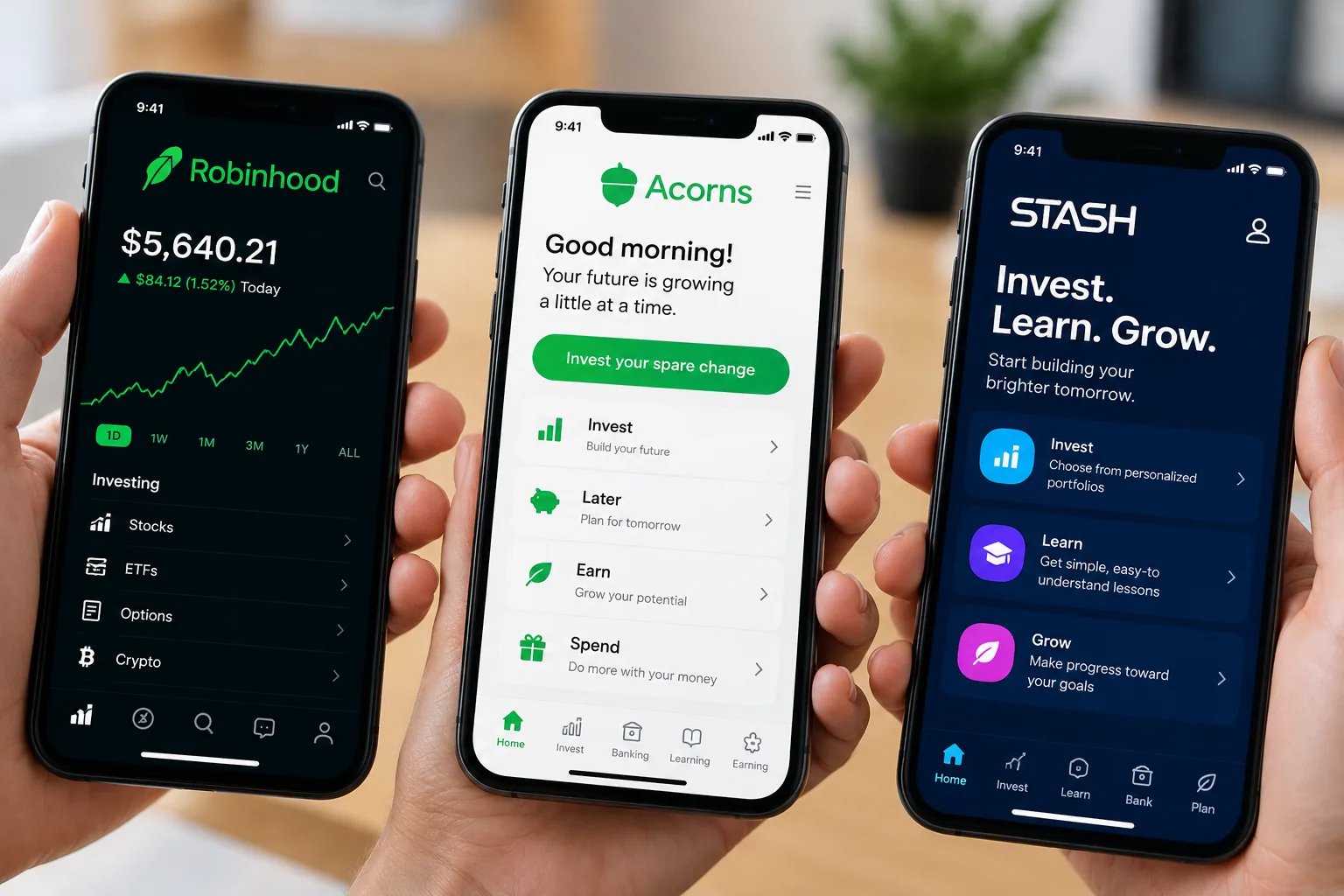
Choosing an investing platform often comes down to how much control you want, how much you are willing to pay, and which account features you plan to use. A Robinhood vs. Acorns vs. Stash comparison shows three different approaches: Robinhood emphasizes self-directed trading, Acorns focuses heavily on portfolio automation, and Stash combines individual investment selection with managed portfolio features.
Each platform can serve a different type of investor. Comparing current subscription costs, available investments, account types, automation, and limitations can help you decide which structure better matches your financial plans.
Robinhood vs. Acorns vs. Stash: Quick Comparison
Current pricing and product information show meaningful differences among the three platforms.
| Feature | Robinhood | Acorns | Stash |
|---|---|---|---|
| Basic platform subscription | No Gold subscription required for standard investing | Bronze $4/mo., Silver $8/mo., Gold $12/mo. for new customers | $12/mo. |
| Premium subscription | Gold: $5/mo. or $50/year | Gold: $12/mo. | Included in $12 plan |
| Individual stocks | Yes | Available through eligible custom portfolio features | Yes |
| ETFs | Yes | Portfolio-based ETF investing | Yes |
| Fractional investing | Yes | Portfolio investments can use fractional positions | Yes |
| Automated portfolio option | Available through separate Robinhood Strategies managed accounts | Yes | Yes, through Smart Portfolio |
| Traditional/Roth IRA | Yes | Yes, through Acorns Later | Yes |
| Custodial investing | Available | Available with eligible plan | Available |
| Crypto | Available through Robinhood Crypto | Not a standard Acorns Invest asset | Not listed among standard Stash stock and ETF investing choices |
Pricing and product availability can change, so prospective customers should verify current terms directly with each provider before opening or funding an account.
How Do the Costs Compare?
Cost deserves attention when conducting an investment app comparison, especially for investors starting with relatively small balances.
Robinhood Gold currently costs $5 per month or $50 annually. A Gold membership is optional; Robinhood's standard self-directed investing functionality does not require a Gold subscription. Gold currently includes eligible benefits such as a 3% IRA contribution match and interest on eligible brokerage cash, subject to applicable terms.
Acorns currently advertises three plans for new customers: Bronze at $4 per month, Silver at $8 per month, and Gold at $12 per month. The features increase by tier, with Gold adding family-focused and additional investing functions.
Stash currently advertises one $12 monthly plan, with an annual billing option of $108. Its plan includes access to personal investing, retirement accounts, Smart Portfolio, custodial accounts, financial guidance, and its Stock-Back Card. Stash states that a 0.25% annual assets-under-management advisory fee applies to Smart Portfolios with balances of $1,000 or greater and Managed Retirement Accounts.
Why Flat Monthly Fees Matter
A flat subscription can have a larger proportional effect on a small portfolio.
For example, $12 per month equals $144 per year. Someone maintaining a relatively small investment balance may therefore want to decide if the included services justify that recurring expense.
This does not automatically make a subscription-based platform unsuitable. An investor who actively uses several included services may evaluate the cost differently from someone who wants basic stock and ETF access.
Which Platform Provides Greater Control Over Investments?
Robinhood gives self-directed investors direct access to stocks and ETFs and supports eligible options trading. It also provides cryptocurrency access outside its IRA products. Self-directed Robinhood IRAs can hold stocks and ETFs, with options available to qualified customers, while cryptocurrency is unavailable inside the IRA.
Stash allows customers to select from thousands of stocks and ETFs while providing a managed Smart Portfolio for people who prefer portfolio management.
Acorns takes a different approach. Its standard service centers on expert-built diversified portfolios instead of requiring users to select individual securities. Gold customers can access Custom Portfolios that add eligible individual stocks and ETFs to their portfolios.
For investors comparing the best investing apps, the practical question may therefore be how much responsibility they want for selecting investments.
Which App Is Better Suited to Automated Investing?
Acorns places automated investing near the center of its service. Its Invest product recommends a diversified portfolio, while Round-Ups can direct spare change from linked spending activity toward investing.
Stash combines automation with greater individual-investment flexibility. Customers can select stocks and ETFs themselves or use Smart Portfolio for managed investing.
Robinhood supports recurring investments in eligible stocks, ETFs, and cryptocurrency. Recurring stock and ETF purchases use dollar-based orders and commonly result in partial-share purchases. Robinhood also has separately managed portfolios through Robinhood Strategies.
The distinction matters. Scheduled purchases automate contributions, while a managed portfolio can handle investment selection and portfolio management on the customer's behalf.
Do All Three Support Fractional Investing?
The ability to purchase fractional shares can make higher-priced securities accessible without requiring enough cash to purchase a full share.
Robinhood permits eligible stocks and ETFs to be purchased fractionally, with fractional orders starting at $1. Not every security qualifies for fractional trading.
Stash states that customers can purchase fractional investments in thousands of stocks and ETFs, including investments starting at $5 or less.
Acorns generally invests customer contributions across portfolio holdings, so customers do not need to purchase whole ETF shares manually.
Fractional investing can make diversification easier with limited funds, though diversification cannot eliminate the possibility of investment losses.
How Do Retirement Accounts Compare?
All three platforms provide options for retirement investing, though their features and incentives differ.
Robinhood provides traditional and Roth IRAs. Its current self-directed IRA program provides a 1% match on eligible annual contributions for customers without Gold and a 3% match for Gold subscribers. Conditions apply, and managed Robinhood Strategies IRAs are excluded from the contribution match.
Acorns Later provides retirement investing within its subscription plans. Current Silver accounts advertise a 1% IRA match on new contributions during the customer's first year, while Gold advertises a 3% first-year match.
Stash provides retirement accounts under its $12 monthly subscription. Its current pricing page advertises a 3% retirement match worth up to $225 annually, subject to its program terms.
Investors comparing these incentives should read eligibility requirements, holding requirements, subscription costs, and other conditions rather than selecting an account based solely on the advertised match percentage.
What Account Features Does Each Platform Provide?
A standard brokerage account may be enough for someone investing outside retirement, yet additional account types can become relevant as financial needs change.
Robinhood provides individual taxable investing accounts along with traditional and Roth IRAs. It now provides custodial accounts as well, with supported features including stocks, ETFs, recurring investments, dividend reinvestment, and managed custodial portfolios. Certain products, including options and cryptocurrency, are excluded from custodial accounts.
Acorns combines investing with retirement, checking, emergency savings, and family products, depending on the subscription selected. Gold includes Acorns Early Invest accounts for children.
Stash's subscription includes personal investing, retirement, Smart Portfolio, and investment accounts for children.
Checking the complete account lineup may be useful for anyone hoping to keep several financial products on one platform.
What Are the Main Advantages and Limitations?
Robinhood
Potential advantages
- No Gold membership is required for standard self-directed investing
- Direct stock and ETF selection
- Eligible fractional-share trading
- Recurring investments
- Traditional and Roth IRAs
- Cryptocurrency availability outside retirement accounts
- Optional Gold membership
Potential limitations
- Some advanced products can involve substantially greater risk
- Crypto cannot be held in a Robinhood IRA
- Investors choosing individual securities remain responsible for portfolio construction
- Certain Gold features require an ongoing subscription
Acorns
Potential advantages
- Portfolio-based investing
- Automatic Round-Ups
- Retirement accounts across current subscription levels
- Family investing features through Gold
- Checking and other financial tools available according to plan
Potential limitations
- Monthly subscription starts at $4 for new customers
- Standard investing emphasizes preconstructed portfolios rather than unrestricted security selection
- Several features require Silver or Gold
- Flat subscription costs can have a greater proportional effect on smaller balances
Stash
Potential advantages
- Individual stocks and ETFs
- Smart Portfolio management
- Retirement and custodial accounts
- Fractional investing
- Stock-Back rewards on qualifying purchases
Potential limitations
- $12 monthly subscription
- Additional advisory fees apply to certain managed accounts
- Stash describes its service as intended for long-term investing rather than day trading
- Market transactions are executed during designated trading windows rather than continuously throughout the trading day.
Which Type of Investor Might Prefer Each Platform?
There is no single platform structure that fits every investor.
Robinhood may suit: People who want direct control over stocks and ETFs, recurring investments, and access to several self-directed trading products without paying for a standard monthly subscription.
Acorns may suit: People who prefer portfolio-based investing and automatic features such as Round-Ups rather than regularly selecting individual investments.
Stash may suit: People who want both individual investment selection and a managed portfolio option and who expect to use enough of its bundled features to justify the subscription.
These descriptions are based on platform structure rather than expected investment performance. Returns depend on the investments held and market conditions, not simply the app used to purchase them.
Frequently Asked Questions
Does Robinhood, Acorns, or Stash have the lowest monthly cost?
Robinhood does not require its $5-per-month Gold subscription for standard self-directed investing. Acorns currently starts at $4 per month for new customers, while Stash currently lists a $12 monthly plan. Optional services and other account-level charges can affect total costs.
Can you invest automatically with all three?
Yes, although the methods differ. Robinhood supports recurring purchases and separately provides managed accounts, Acorns centers its service around automated portfolios, and Stash provides recurring investment tools alongside Smart Portfolio management.
Can you open an IRA with all three?
Yes. Each platform currently provides retirement-account options. Features, fees, investment choices, matching programs, and eligibility requirements vary by provider and account type.
Are investing apps suitable for beginners?
They can be, depending on the person's financial knowledge and preferred level of involvement. Automated portfolios may reduce the decisions a new investor needs to make, while self-directed platforms provide greater control but require the customer to choose investments.
What Should You Check Before Choosing an Investing App?
Before opening an account, compare:
- Monthly subscription and advisory fees
- Investments available through the platform
- Taxable and retirement account choices
- Portfolio management and automation
- Trading restrictions and execution methods
- Fractional-investment availability
- IRA match conditions and holding requirements
- Custodial or family account availability
- Cash-management features
- Transfer, withdrawal, and account-closing fees or restrictions
Small differences can become relevant depending on your balance and how frequently you use the included features.
Final Thoughts on Robinhood vs. Acorns vs. Stash
The Robinhood vs. Acorns vs. Stash comparison highlights three different approaches to personal investing.
Robinhood leans toward self-directed investing and provides an optional premium subscription. Acorns focuses heavily on automated portfolios, recurring contributions, and financial products packaged into monthly plans. Stash combines self-directed stock and ETF investing with managed portfolio features under a subscription model.
Instead of focusing solely on the lowest advertised price, compare the services you expect to use, investment selection, account types, recurring charges, portfolio management, and restrictions. Platform features and pricing can change, so checking the latest disclosures and fee schedules before opening an account can help prevent surprises.
Investing involves risk, including possible loss of principal. Account features, promotional matches, rates, pricing, and eligibility requirements can change.