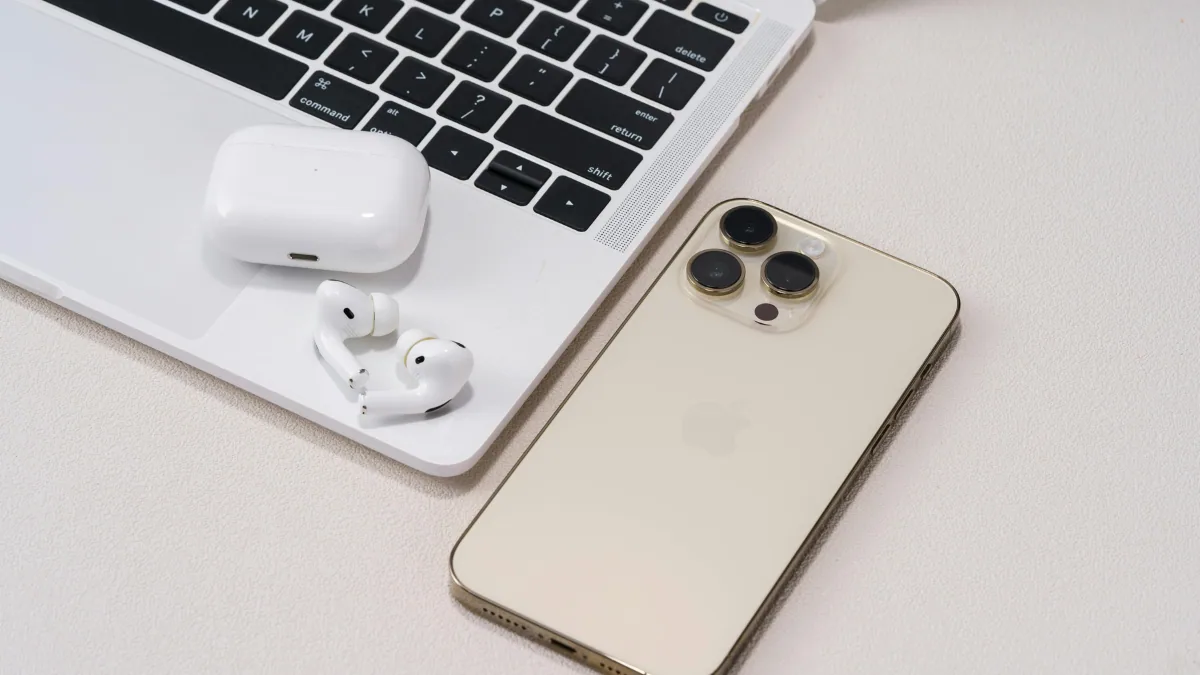
Apple has spent five decades turning computers, phones, tablets, watches, software, and digital services into a business that generated $416.2 billion in net sales during its 2025 fiscal year. Yet some of the most useful facts about Apple go back long before the iPhone became its largest product category.
The company dates to April 1, 1976, and its early years included a third co-founder who quickly left, an Apple I computer, and a first logo that looked nothing like today's bitten-apple symbol. Decades later, the iPhone accounts for roughly half of Apple's annual net sales, while Services has developed into another major source of sales.
Here are 15 company-focused facts covering Apple's history, business, products, financial performance, and several milestones that helped shape the company people know today.
1. Apple Was Founded on April 1, 1976
One of the first Apple company facts to know is the date the business began. Apple traces its founding to April 1, 1976, giving the company 50 years of history as of 2026.
The original Apple Computer Company partnership involved Steve Jobs, Steve Wozniak, and Ronald Wayne. A surviving partnership agreement dated April 1, 1976, bears the signatures of all three founders.
Wayne's involvement was brief. An amendment to the partnership agreement was dated April 12, 1976, less than two weeks after the original agreement.
Apple's earliest years centered on personal computers, long before phones, tablets, watches, streaming subscriptions, and cloud services became part of its business.
2. Apple's First Product Was the Apple I
The Apple I sits near the beginning of Apple history and shows how different the company was during its earliest days.
Steve Wozniak designed the computer, which was sold as a circuit board rather than the polished, fully integrated devices associated with Apple today.
The Apple I was followed by the Apple II, which became one of the products that established the company in personal computing. Apple itself now lists the Apple II among the landmark products from its first 50 years.
That early focus on personal computers eventually led to the Macintosh and later to several product categories far outside desktop computing.
3. Apple's First Logo Featured Isaac Newton
The familiar bitten apple was not Apple's original logo.
The first design, credited to Ronald Wayne, depicted Isaac Newton sitting beneath an apple tree. The detailed illustration bears little resemblance to the simplified Apple symbol recognized today.
Apple later adopted the bitten-apple design associated with graphic designer Rob Janoff.
The early Newton artwork is one of the interesting facts about Apple because it shows how dramatically the company's visual identity changed during its first years. The modern symbol uses a far simpler design that can work across devices, packaging, stores, websites, and software.
4. The Macintosh Arrived in 1984
The Macintosh became a defining part of Apple company history after its introduction in 1984.
Apple credits the Macintosh with helping shape its role in personal technology. The Mac eventually developed into several desktop and laptop lines and remains a significant business category decades after the original Macintosh debuted.
In fiscal 2025, Mac generated approximately $33.7 billion in net sales, according to Apple's Form 10-K. That was up from about $30 billion in fiscal 2024.
The numbers show that a product family with roots in the 1980s still contributes billions of dollars to Apple's annual business.
5. The iPod Arrived Years Before the iPhone
Apple introduced the iPod in 2001. The portable music player became an important part of the company's expansion beyond traditional computers.
Its influence lasted well beyond the original device. When Steve Jobs introduced the first iPhone in 2007, Apple described the new device partly as a widescreen iPod with touch controls.
Apple eventually ended the iPod product line. On May 10, 2022, the company announced that the iPod touch would remain available only while supplies lasted.
By then, many functions once associated with the iPod had shifted to the iPhone, Apple Watch, iPad, Mac, and Apple's digital services.
6. Apple Introduced the iPhone in 2007
Few Apple products have affected the company's finances as much as the iPhone.
Steve Jobs introduced the original iPhone on January 9, 2007. Apple presented it as a device combining a mobile phone, a widescreen iPod with touch controls, and an internet communications device.
The original U.S. pricing started at $499 for a 4GB model and $599 for an 8GB model. Those prices were tied to Apple's exclusive U.S. carrier arrangement with Cingular at the time.
The iPhone went on sale in the U.S. in June 2007.
A decade after the announcement, Apple said it had sold over one billion iPhones.
7. The iPhone Still Generates About Half of Apple's Annual Net Sales
Nearly two decades after its debut, the iPhone remains Apple's largest sales category.
Apple reported approximately $209.6 billion in iPhone net sales during fiscal 2025, compared with $201.2 billion in 2024.
Total company net sales were about $416.2 billion in 2025. Based on those reported figures, the iPhone accounted for roughly 50% of Apple's annual net sales.
That dependence matters when assessing the business. Apple earns money from several hardware categories and services, yet iPhone performance can still have a significant effect on companywide results.
Apple said higher sales of Pro models helped increase iPhone net sales during fiscal 2025.

8. Apple's Annual Net Sales Passed $400 Billion in Fiscal 2025
Current Apple revenue figures show how large the business has become.
According to Apple's 2025 Form 10-K, the company reported:
| Fiscal Year | Total Net Sales |
|---|---|
| 2023 | $383.3 billion |
| 2024 | $391.0 billion |
| 2025 | $416.2 billion |
Net sales increased about 6% from fiscal 2024 to fiscal 2025.
Still, annual sales alone do not tell investors or consumers everything about a company's financial position. Expenses, margins, cash flow, product demand, regional performance, and other factors can affect the financial picture.
Apple's filings, for example, show that individual categories and geographic regions do not always move in the same direction.
9. Services Generated Over $109 Billion in Fiscal 2025
Hardware gets much of the public attention, yet Apple's Services business has become a major part of its financial results.
Services produced approximately $109.2 billion in net sales in fiscal 2025, up 14% from about $96.2 billion in 2024.
Apple said the increase primarily came from advertising, the App Store, and cloud services.
The Services category includes activity tied to digital platforms and subscriptions rather than relying entirely on customers purchasing a new physical device.
Its growth gives Apple another major source of sales alongside the iPhone and its other hardware categories.
10. Services Has a Much Higher Gross Margin Than Apple's Products Business
Sales tell one part of the financial story. Gross margin provides another useful comparison.
In fiscal 2025, Apple's product business generated approximately $112.9 billion in gross margin. Services generated about $82.3 billion.
Apple reported a 75.4% gross margin percentage for Services, compared with 36.8% for Products in fiscal 2025.
That difference helps explain why Services can have an outsized financial role even though its net sales remain below Apple's combined hardware sales.
For readers evaluating Apple as a business, this distinction can be as informative as looking at sales by product category alone.
11. Apple Introduced the iPad in 2010
The iPad arrived on January 27, 2010, roughly three years after Apple unveiled the iPhone.
At launch, Apple positioned the tablet for activities such as web browsing, email, photos, video, music, games, and digital books. The original model was announced with a starting price of $499 in the U.S.
The iPad later became another multibillion-dollar category.
Apple reported about $28 billion in iPad net sales during fiscal 2025, up 5% from approximately $26.7 billion a year earlier. The company attributed the increase primarily to higher sales of the iPad Air, iPad mini, and standard iPad, partly offset by lower iPad Pro sales.
12. Apple's Major Businesses Extend Far Beyond the iPhone
Apple's business is often closely associated with the iPhone, yet its financial filings separate sales into five major categories.
Here is how those categories performed in fiscal 2025:
| Category | Fiscal 2025 Net Sales |
|---|---|
| iPhone | $209.6 billion |
| Services | $109.2 billion |
| Wearables, Home and Accessories | $35.7 billion |
| Mac | $33.7 billion |
| iPad | $28.0 billion |
| Total | $416.2 billion |
The table highlights two points. The iPhone remains Apple's largest individual category, while Services has grown into the clear second-place category by annual net sales.
It also shows why describing Apple solely as a smartphone company leaves out a substantial portion of its business.
13. Not Every Apple Business Grew in Fiscal 2025
Apple's overall net sales increased in fiscal 2025, yet one major category declined.
Wearables, Home and Accessories generated approximately $35.7 billion, down 4% from roughly $37 billion in fiscal 2024.
Apple attributed the decline primarily to lower sales of accessories and wearables.
Regional performance varied as well. Apple's 2025 filing reported higher net sales in the Americas, Europe, Japan, and the rest of Asia Pacific. Greater China moved in the opposite direction, with lower iPhone net sales contributing to a year-over-year decline in the region.
These figures provide useful context when looking at companywide growth. A higher total does not mean every business category or geographic market increased at the same pace.
14. Apple Says It Supports 2.9 Million U.S. Jobs
Apple's economic footprint extends beyond employees who work directly for the company.
In 2025, Apple said it supported over 2.9 million jobs in the United States through direct employment, U.S.-based suppliers and manufacturers, and employment connected with the iOS app economy.
The wording matters. The 2.9 million figure does not mean Apple directly employs that many people. It includes several categories of jobs associated with Apple's broader economic activity.
For comparison, Apple's earlier job-creation materials cited 2 million U.S. jobs, showing how the company's stated employment footprint has changed over time.
15. Apple Reached Its 50th Anniversary in 2026
Apple marked its 50th anniversary on April 1, 2026.
The milestone connects two very different versions of the same company. Apple began in 1976 around early personal computing and now operates businesses spanning smartphones, computers, tablets, wearables, digital payments, cloud services, streaming, apps, and other technology.
Its product history includes the Apple II, Macintosh, iPod, iPhone, iPad, Apple Watch, Mac, and Apple Vision Pro.
Financially, fiscal 2025 ended with $416.2 billion in total net sales. Apple also announced in 2025 that it planned to spend and invest over $500 billion in the U.S. across the following four years, covering areas such as suppliers, manufacturing, research and development, infrastructure, facilities, and Apple TV+ productions.
What Do These Facts Say About Apple's Business?
Taken together, these facts about Apple show a company that has repeatedly expanded into new product categories while retaining businesses created decades earlier.
The Mac remains a multibillion-dollar category decades after the Macintosh appeared. The iPhone, introduced in 2007, now produces roughly half of annual net sales. Services generated over $109 billion in fiscal 2025 and carries a substantially higher gross margin percentage than the Products segment.
There are limitations worth keeping in mind. Product categories can rise or fall from one fiscal year to another, regional results can differ, and historical sales figures should always be attached to their reporting periods. Current figures can change when Apple publishes its next annual results.
For anyone researching Apple as a company, looking at both its product milestones and its financial filings provides a clearer picture than relying on trivia alone.
Looking at Apple After 50 Years
The most useful Apple company facts connect the company's past with the business it operates today. Early computers established its place in personal technology, while later launches such as the iPod, iPhone, and iPad expanded the company's reach into other consumer-device categories.
The financial numbers now tell another part of the story. The iPhone remains the largest category, Services has become a major contributor, and Mac and iPad continue to generate tens of billions of dollars in annual net sales.
For readers studying Apple history, the contrast between a three-person partnership in 1976 and a company recording $416.2 billion in fiscal 2025 net sales helps put five decades of change into perspective.