A sell order can go through and still leave shares sitting in the account. A buy order can sit for weeks and buy nothing at all.
Both are ordinary outcomes, and both trace back to one choice the brokerage makes you settle before it will take the trade: market or limit.
What you're picking is whether the price you pay matters more to you than owning the shares today.
Price Control Versus a Guaranteed Fill
Every other detail follows from that trade-off.
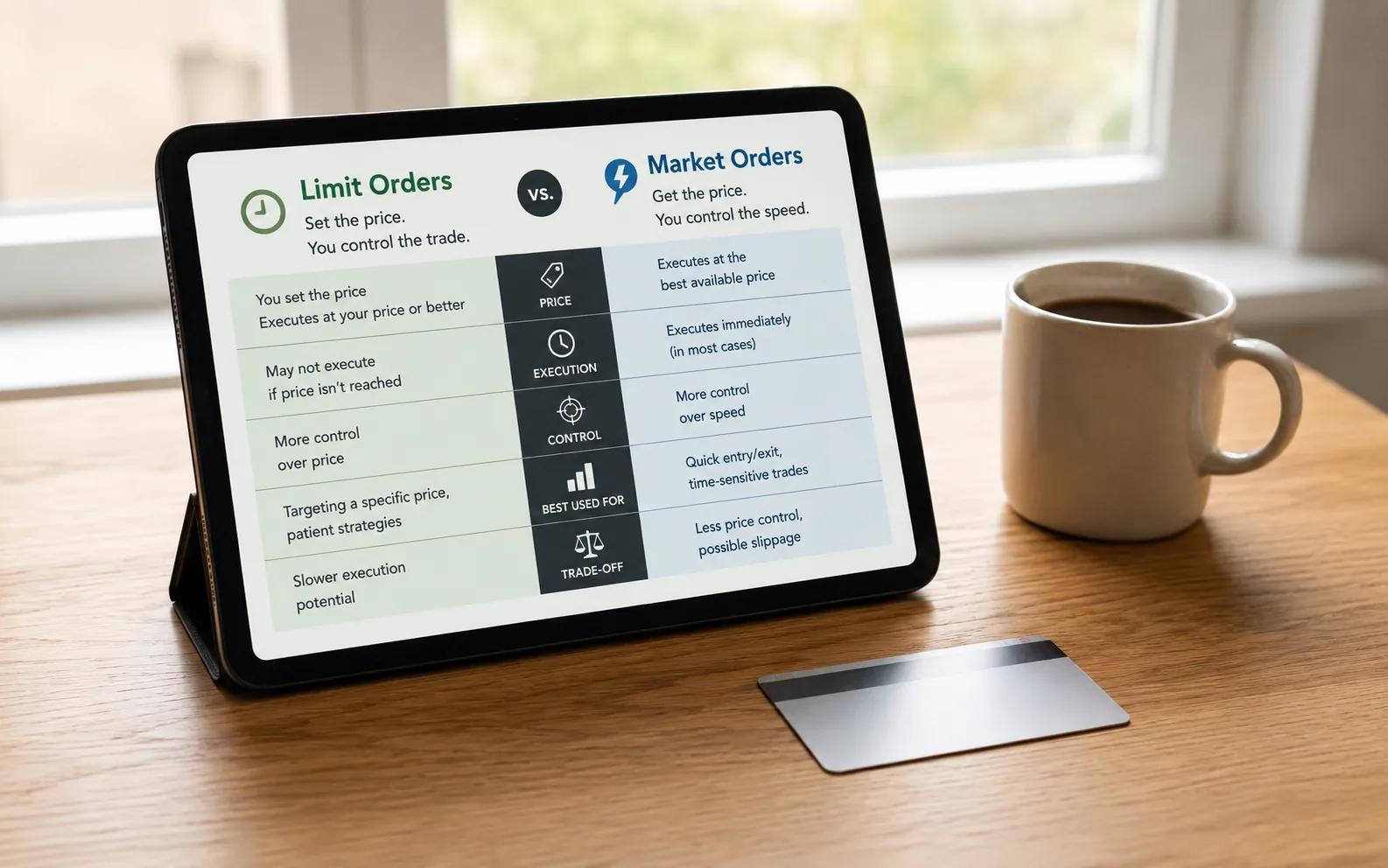
A market order prioritizes execution. Whatever the market is paying when your order arrives, that's your price, and the whole quantity trades. The price can shift between the tap and the fill; the order goes through regardless.
A limit order prioritizes price. You name the price, and the trade only happens at that price or better. If the market never gets there, nothing happens.
| Market Order | Limit Order | |
|---|---|---|
| Price you get | Best available at the time | Your stated price or better |
| Does the whole order fill? | Yes, the full order executes | Maybe not, or only partly |
| When it happens | At the time you place it | Possibly hours, days, or weeks later, or never |
| What you give up | Control over the price | Certainty that it trades |
A Buy Limit at $10 While the Stock Trades at $12
Say an investor wants 100 shares and won't pay more than $10 each, so the buy limit goes in at $10 with a 30-day expiration. The stock is at $12 that day. The order does nothing.
Two weeks in, the price slides under $10. Now the order is live, and the broker starts buying at $10 or below, taking whatever is on offer at those prices. If the market only supplies part of the 100 shares that cheaply, that's the part the investor ends up with.
That's the appeal for a buyer: the order sits there waiting for a price the investor considers a reasonable entry point, instead of taking whatever the screen shows at the moment of the click.
A Sell Limit Can Leave You Holding the Leftovers
The same mechanic runs in reverse, and this is where the partial-fill problem gets easier to see.
An investor holding a stock trading at $30 per share sets a sell limit order for 20 shares at $35. If the stock reaches $35, the trade executes, assuming it can. Suppose only eight shares can be sold at $35 per share. Those eight sell. The remaining 12 shares stay in the account.
If the price never returns to $35, the investor is still holding those 12 shares, and the sell order that looked like a clean exit only did part of the job.
Limit Orders Expire, and the Clock Depends on Your Broker
A limit order isn't a standing instruction that lasts forever. How long it lives depends on the brokerage and the option you select when placing it:
- Day orders expire at the end of the trading day if the trade hasn't been fulfilled.
- Good-'til-canceled (GTC) orders last longer, weeks or months, but not indefinitely.
Because the specifics vary between platforms, the expiration setting is worth reading before you place the order rather than after. Some brokers also treat regular-hours and extended-hours sessions differently, which affects when an order is even eligible to fill.
An Unfilled Limit Order Ends in a Cancellation, an Expiration, or a Late Fill
While the price stays away from your limit, the order simply sits there. It comes off the books in one of three ways: you cancel it yourself, the expiration you chose arrives, or the market eventually comes to your price and the thing fills after all.
One subtlety worth knowing: seeing the price touch your limit on a chart doesn't guarantee your order traded. Orders queue up, and there has to be someone on the other side of the trade at that price for your shares specifically. That's the same reason partial fills happen.
Limit Orders Cover Stocks, ETFs, and Crypto, Not Mutual Funds
Anything that trades continuously through the session can take a limit order. Stocks and ETFs qualify, and so does cryptocurrency.
Mutual funds don't, and the reason is in how they price: fund orders are all filled at the net asset value calculated once the market closes, so there's no running price for a limit to sit against during the day.
If you want to use a limit order, the feature is standard rather than specialized. It shows up on investing apps like Robinhood and Webull and at full-service brokerages like Vanguard and Fidelity alike.
A Stop-Limit Order Adds a Trigger Before the Limit Starts
A stop-limit order is a limit order with an extra step in front of it. Nothing happens until the asset hits a specific stop price. Once it does, the system places a limit order according to the terms you set.
A seller might put the stop at $10 per share and set the limit at $9.50 or better. Compare that with a plain sell limit at $10: if not every share could sell at exactly $10, the seller could end up still holding shares.
The half-dollar of slack does its work when a price is falling quickly. By the time the $10 stop trips, the bids on the other side may already sit below $10, and an order willing to take anything down to $9.50 can still meet them. One pinned to $10 can't.
Active Traders and Buy-and-Hold Investors Use Them Differently
Active traders often build their decisions around price relative to other factors, like earnings. A position may only make sense to them within a specific price range, and a limit order enforces that: it trades when their conditions are met and skips the trade when they aren't. For that style, an order that never executes isn't a failure; it's the whole point of using one.
The buy-and-hold case runs on different arithmetic. When the plan is to keep a position for decades, the price paid on any one purchase is a small input to the final number, and the fraction of a dollar that separates one morning's price from another's is smaller still. Getting the money invested is the job, and a market order does that.
There is one situation where the usual split blurs. Trading large quantities of a low-volume investment can cause the price to swing sharply, and a limit order caps how far the fill price can drift in that case, a scenario that can apply to a long-term investor as easily as a trader.
What Limit Orders Cost: No Fill, a Partial Fill, or a Long Wait
The upside is the control: purchases and sales fill at your stated price or better, when they fill at all.
The costs sort themselves by how much of the order you end up with:
- None of it. Hold the line on price and the market may simply never come to you, so the shares never get bought or the position never gets sold.
- Some of it. When only half the order can transact at your price, half the shares is what you own.
- All of it, later. Execution could come hours, days, or weeks after you placed the order, if it comes.
When Each One Fits, and Three Settings to Check First
A limit order makes sense when the price matters more than owning the asset, when passing on the trade is an acceptable outcome. A market order makes sense when the reverse is true and the priority is getting the full position filled now.
Neither is the safer choice in the abstract; they fail in opposite directions, one by leaving you unfilled, the other by filling at a price you never saw coming.
Three settings shape how either behaves, and all three are visible before the order goes in: the expiration option, whether the platform supports the order type for the asset you're buying, and what happens if only part of the order can trade.