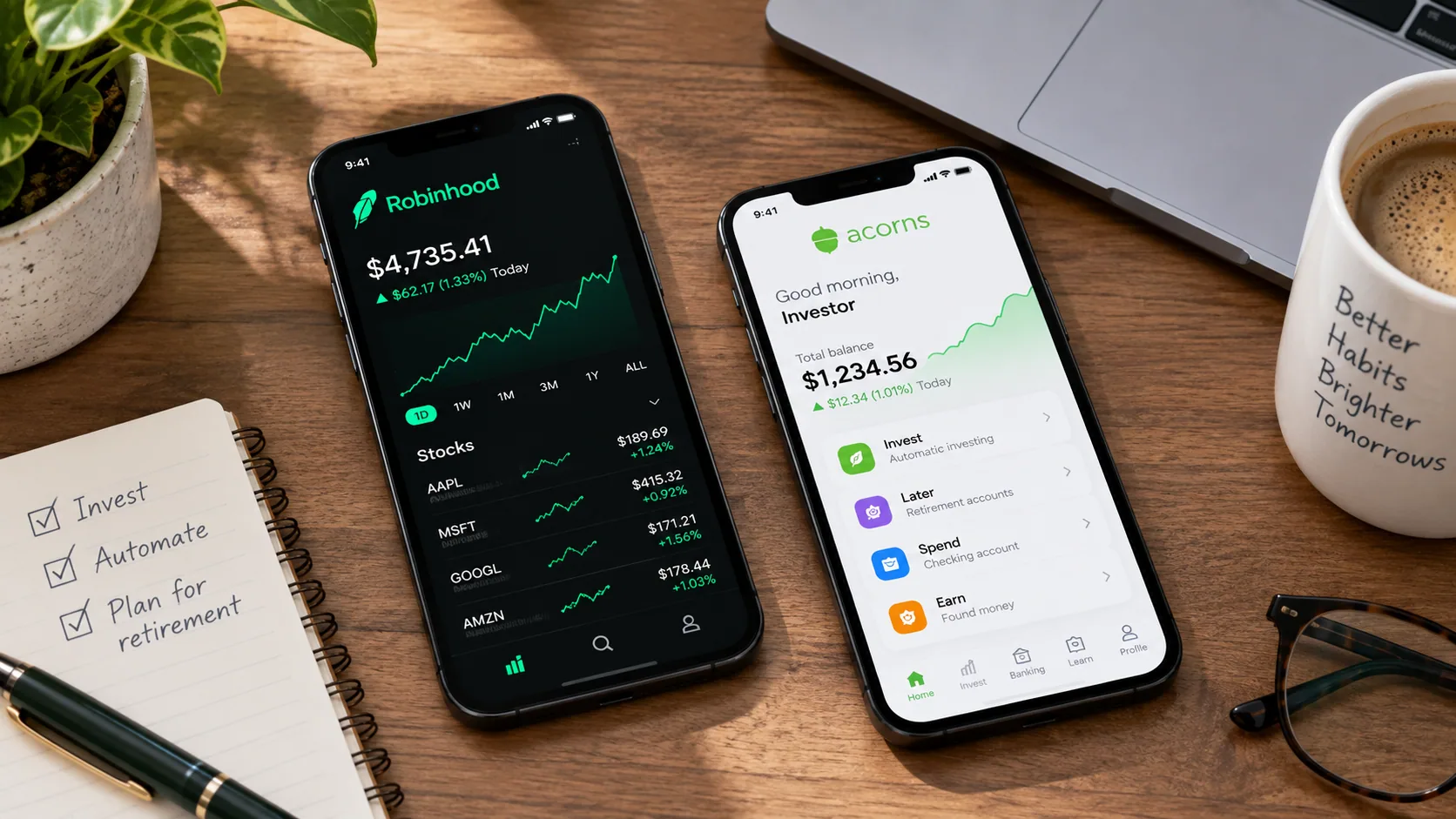
Choosing between Robinhood vs. Acorns largely comes down to how involved you want to be with your investments. Robinhood gives self-directed investors extensive control over what they buy and sell, while Acorns centers its service on portfolios, recurring contributions, and automatic features.
Both belong to the growing category of investment apps, yet their pricing and investing experiences differ considerably. Robinhood may suit people who want to select securities themselves. Acorns may suit people who prefer an account that handles much of the portfolio management automatically.
The comparison has changed in recent years, too. Robinhood now has a managed portfolio service called Robinhood Strategies, while Acorns Gold permits eligible users to customize part of their portfolios with individual stocks and ETFs. Those additions make the distinction between the platforms less absolute than it once was.
Robinhood vs. Acorns: Quick Comparison
| Feature | Robinhood | Acorns |
|---|---|---|
| Standard pricing approach | No monthly subscription required for standard self-directed brokerage access | Monthly subscription |
| Current paid plan | Gold: $5/month or $50/year | Bronze: $4/month; Silver: $8/month; Gold: $12/month |
| Primary investing approach | Self-directed | Managed portfolio |
| Stocks and ETFs | Yes | ETF-based portfolios; customization available with eligible Gold plan |
| Options | Yes, subject to eligibility | No standard self-directed options trading |
| Crypto access | Available through Robinhood Crypto | Bitcoin-linked ETF exposure can be incorporated into eligible portfolios |
| Retirement investing | Available | Available |
| Automatic portfolio management | Available through Robinhood Strategies | Central part of Acorns |
| Spare-change investing | No direct equivalent | Yes |
| Margin | Available to eligible Robinhood customers | Not a standard Acorns feature |
Pricing and product availability can change. Investors should verify current terms with each company before opening or funding an account.
How Robinhood and Acorns Approach Investing Differently
Robinhood's self-directed brokerage service gives investors direct control over investment selection. Its supported securities include U.S. exchange-listed stocks, ETFs and certain other securities, with options available to eligible customers. Separate Robinhood services provide access to cryptocurrency and certain futures products.
Electronic trades of eligible U.S.-listed securities in Robinhood self-directed accounts generally qualify for commission-free trading, although regulatory, exchange and other charges can still apply. That distinction matters because a "$0 commission" does not mean every possible transaction or service has no cost.
Acorns starts from a different premise. Its standard investing service recommends a diversified portfolio based on information supplied during account setup and handles ongoing portfolio activity. The service uses ETFs across its base portfolios and provides automatic features designed to reduce the amount of routine account management required from the customer.
That makes Acorns closely associated with automated investing, although Gold subscribers can gain added customization through Custom Portfolios.
How Much Do Robinhood and Acorns Cost?
Cost is one of the clearest differences.
Robinhood does not charge a monthly subscription for its standard self-directed investing account. Its optional Gold membership currently costs $5 per month or $50 annually. Gold includes added features such as enhanced eligible cash benefits, the first $1,000 of eligible margin borrowing included in the subscription, and a higher match on eligible self-directed IRA contributions.
Acorns uses subscriptions. As of September 2026, customers signing up from August 17, 2026 onward pay:
- Bronze: $4 per month
- Silver: $8 per month
- Gold: $12 per month
Acorns' regulatory disclosure states that customers who signed up on or before August 16, 2026 may remain under earlier Bronze and Silver pricing of $3 and $6 per month, respectively.
The effect of a flat subscription depends partly on the account balance. For example, $48 in annual Bronze charges equals 4.8% of a hypothetical $1,000 balance before investment expenses or market performance are taken into account. At a $10,000 balance, the same $48 equals 0.48%.
That calculation does not represent investment performance or the full economic value of the plan. It simply shows why investors with small balances may want to calculate subscription costs as a percentage of the amount they expect to invest.
Which Platform Gives You Greater Control Over Investments?
Robinhood's self-directed brokerage generally gives investors greater control over individual security selection.
Eligible stocks and ETFs can be purchased as fractional shares, with Robinhood stating that supported fractional orders can start at $1. This can help investors allocate smaller dollar amounts across several eligible securities without buying full shares.
Acorns base portfolios operate differently. Customers typically receive a recommended diversified portfolio rather than building the entire allocation security by security. Gold's Custom Portfolios feature adds the ability to include individual stocks and ETFs alongside the diversified portfolio.
Investors who enjoy researching securities may prefer the control associated with Robinhood's self-directed service. Those who prefer portfolio guidance and automatic management may find Acorns' structure easier to maintain.
How Does Acorns Automate Everyday Investing?
Acorns Round-Ups links everyday spending with investing. After eligible purchases are made through linked accounts with the feature activated, Acorns calculates the difference between each purchase and the next whole dollar. Pending amounts are transferred for investment once they reach the applicable threshold.
Acorns states that standard Round-Ups investments are processed once pending amounts reach at least $5. The transferred funds are then invested in the customer's Acorns Invest portfolio.
Customers can also schedule recurring investments. Portfolio management features include rebalancing, which can help keep holdings aligned with their designated allocation.
These functions may suit people who prefer frequent small contributions rather than manually placing trades. Users should still monitor linked checking balances because Acorns notes that insufficient funding for Round-Ups could result in overdraft charges from the customer's financial institution.
What Retirement Choices Are Available?
Both companies support IRA accounts, though their structures and incentives differ.
Robinhood supports self-directed retirement investing and currently provides a 1% match on eligible annual IRA contributions for customers without Gold. Eligible Gold subscribers can receive a 3% match on annual contributions. Robinhood requires customers receiving the Gold contribution match to maintain Gold for at least one year after the first Gold match, while assets earning a match generally need to remain in the IRA for at least five years to avoid a potential early match removal fee.
Acorns Later can be structured as a Traditional, Roth or SEP IRA. Under its current program, eligible new Silver subscribers can receive a 1% match on new contributions during their first subscription year, while eligible new Gold subscribers can receive a 3% match, subject to program rules and limits.
Investors evaluating either retirement program should review contribution limits, eligibility rules, holding requirements and tax consequences before moving retirement assets.
Does Robinhood Have an Automated Portfolio Service?
Yes. Robinhood Strategies provides managed portfolios through Robinhood Asset Management.
The service currently charges an annual management fee of 0.25% of assets under management. Eligible Gold customers pay that management fee only on the first $100,000 held in each managed account under the current fee structure.
This service means Robinhood can no longer be described solely as a platform where every investor must select every security personally.
Still, Robinhood's self-directed brokerage remains substantially different from Acorns' subscription-centered managed investing structure. A shopper comparing the platforms should decide which specific Robinhood service they plan to use rather than treating every Robinhood account as identical.
What Are the Main Advantages of Robinhood?
Robinhood may fit investors who want:
- Direct control over security selection
- No required monthly subscription for standard self-directed brokerage access
- Access to eligible stocks, ETFs and options
- Separate access to cryptocurrency
- Dollar-based purchases of eligible securities
- Optional margin access for qualifying customers
- Self-directed retirement investing
- An optional paid membership with added account features
The primary tradeoff is responsibility. Having extensive control means the investor must decide what to purchase, when to trade and how to allocate the portfolio.
Some products available through Robinhood carry substantial risk. Options, futures, margin borrowing and cryptocurrency each introduce risks that may exceed those associated with a diversified long-term ETF portfolio.
What Are the Main Advantages of Acorns?
Acorns may fit investors who value:
- Portfolio recommendations
- Automatic recurring contributions
- Automatic portfolio rebalancing
- Spare-change investment features
- Retirement investing within the same service
- Family-focused investment features through eligible plans
- A subscription structure that bundles several financial tools
The main drawback is the recurring subscription charge. Customers pay the monthly plan price regardless of the amount held in their investment account, so those starting with relatively small balances may find the fee proportionally significant.
Gold provides added features, including Custom Portfolios and Acorns Early Invest. Acorns currently lists Acorns Early Invest as exclusive to Gold.
Robinhood or Acorns for Beginners?
Either platform can serve a beginner, though they address different needs.
Acorns can reduce the number of investment decisions a new investor needs to make. Its recommended portfolios and automatic contributions may suit someone who wants a structured approach.
Robinhood gives beginners greater freedom to select investments. That flexibility can be useful for someone willing to research securities and learn how orders, diversification, asset allocation and investment risk work.
A simple interface does not reduce market risk. Investors can lose money on either platform when investment values decline.
Can You Use Both Robinhood and Acorns?
Yes. Using one platform does not generally prevent an investor from maintaining an account with the other.
Someone could theoretically use Acorns for a managed portfolio and Robinhood for selected self-directed holdings. Doing so can create additional recordkeeping, tax documents and account-management responsibilities.
Using two platforms also does not automatically improve diversification. Diversification depends on the underlying holdings and their exposure, not the number of apps installed.
Robinhood vs. Acorns: Which Type of Investor Might Prefer Each?
The strongest distinction is still control versus automation.
Robinhood's self-directed service may fit investors who want to research and select their own securities, access several investment types, and avoid a required monthly subscription for a standard brokerage account.
Acorns may fit investors who want recurring contributions, portfolio recommendations and automatic account management bundled under a monthly plan.
Yet neither choice needs to be permanent. Investment needs can change as account balances, financial goals and investing experience change.
Before opening either account, compare the current subscription or advisory charges, investment selection, retirement rules, account services and risk disclosures directly with the provider. Product terms can change, and a feature that looks attractive today may carry conditions that affect its practical value.
Frequently Asked Questions
Is Robinhood cheaper than Acorns?
For standard self-directed brokerage access, Robinhood does not require a monthly subscription, while Acorns currently uses monthly plans starting at $4 for new subscribers. Robinhood Gold and Robinhood Strategies carry their own charges, so the relevant cost comparison depends on the services being used.
Does Acorns let you pick individual stocks?
Eligible Acorns Gold customers can use Custom Portfolios to add individual stocks and ETFs to their diversified portfolio. Acorns' base investing service still centers on recommended portfolios.
Can Robinhood manage a portfolio automatically?
Robinhood Strategies provides managed portfolios for a 0.25% annual management fee under its current pricing structure. Eligible Gold members currently pay management fees only on the first $100,000 in each managed account.
Does Robinhood charge commissions?
Robinhood states that electronic trading of eligible U.S.-listed and certain OTC securities in its self-directed individual cash or margin investing accounts carries no commission. Other charges can apply, including certain regulatory, exchange and product-specific fees.
Is Acorns worth paying a monthly subscription?
That depends on the account balance and which Acorns features a customer expects to use. Investors can calculate the annual subscription cost against their expected balance and assess how much they value portfolio management, recurring investments, Round-Ups and other plan features.
Final Thoughts on Robinhood vs. Acorns
Robinhood vs. Acorns is primarily a comparison between two approaches to personal investing. Robinhood's self-directed brokerage emphasizes investor control and broad product access, while Acorns emphasizes managed portfolios, recurring contributions and automation.
Robinhood has expanded into managed investing, and Acorns Gold has expanded into customizable portfolios, so the boundary between them is less rigid than older comparisons may suggest.
Fees deserve particular attention. Robinhood's standard self-directed brokerage does not require a monthly subscription, while Acorns' recurring plan cost can represent a noticeable percentage of a small investment balance. Robinhood's optional Gold membership and managed account service introduce separate charges and conditions.
The right fit depends on how much control you want, which assets you plan to hold, how often you expect to interact with your account, and how the applicable fees compare with the amount you plan to invest. Reviewing the latest terms and disclosures before opening an account can help prevent outdated pricing or promotional terms from influencing the decision.