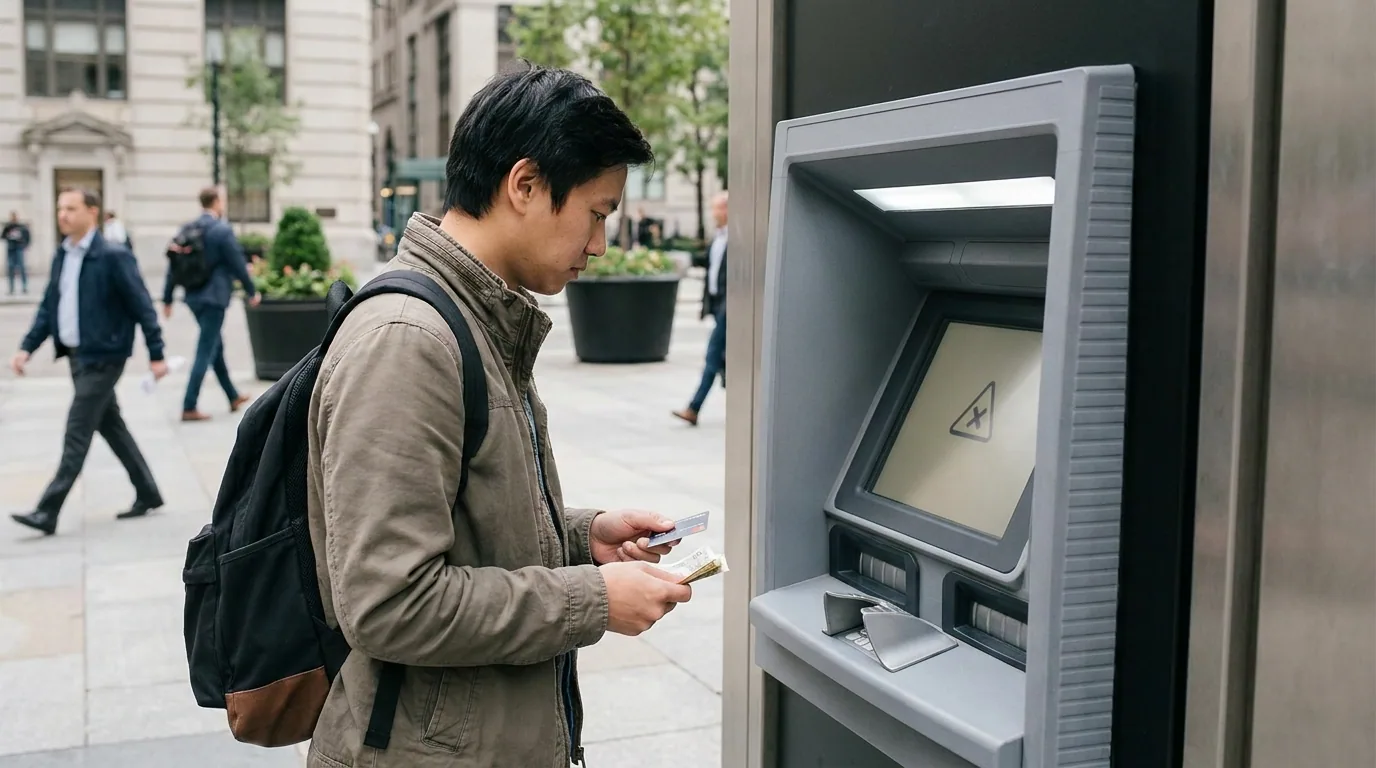
Withdrawing $40 from an ATM can cost substantially above $40 when the machine is outside your bank's network. In the U.S., an out-of-network withdrawal can result in two ATM fees: one charged by the ATM operator and another charged by your own bank or credit union.
The average combined cost reached a record $4.86 per transaction in 2025, according to Bankrate's annual checking-account study.
Those charges may seem small individually, but frequent withdrawals can turn them into a recurring banking expense. Knowing who charges each fee, when you'll see it, and which alternatives are available can help you keep the cost down.
How ATM Fees Work
The first thing to know about ATM fees is that a single withdrawal can produce charges from two different companies.
When you use an ATM outside your bank or credit union's network, the machine's operator may charge a surcharge. Your own financial institution may separately charge an out-of-network ATM fee. The Consumer Financial Protection Bureau (CFPB) confirms that both charges are permitted.
Bankrate's 2025 study found these average charges:
| Type of ATM fee | 2025 average |
|---|---|
| ATM operator surcharge | $3.22 |
| Your bank's out-of-network fee | $1.64 |
| Combined average | $4.86 |
These are averages rather than mandatory charges. Your actual cost depends on the ATM, your financial institution, your account, and any fee-reimbursement benefits.
At an average of $4.86, making one out-of-network withdrawal every week would cost roughly $253 a year.
1. Use Your Bank's In-Network ATMs
The simplest way to avoid ATM fees is usually to stay inside your financial institution's ATM network.
Banks commonly provide an ATM locator through their website or mobile app. Some institutions participate in larger networks, which can give customers access to participating machines beyond their own branches.
Check your bank's current network before withdrawing. A machine being nearby doesn't necessarily mean it's free for your particular debit card.
2. Watch for Two Separate Charges at Out-of-Network ATMs
An ATM displaying a $3 fee doesn't necessarily mean $3 is the entire cost of the transaction.
The machine operator can impose its surcharge, while your bank can separately charge an out-of-network fee. That's how one withdrawal can produce two charges.
For example, if an ATM operator charges $3 and your bank charges $2 for using another network, accessing your own cash costs $5.
Check your bank's account agreement or fee schedule to find out what it charges for out-of-network withdrawals.
3. Read the ATM Fee Disclosure Before Continuing
U.S. federal rules give consumers an opportunity to see an ATM operator's fee before completing a transaction.
Under Regulation E, an ATM operator that charges consumers for an electronic fund transfer or balance inquiry must disclose the fee amount on the ATM screen or on paper before the consumer is committed to paying it. The operator can impose the fee only after providing that notice and the consumer chooses to continue.
That means you can cancel when an ATM displays a surcharge you don't want to pay.
Keep in mind that this disclosure concerns the ATM operator's fee. Your own financial institution may have a separate out-of-network charge disclosed under your account terms.
4. Get Enough Cash in One Withdrawal
When an ATM fee applies per transaction, several small withdrawals can become expensive.
Suppose each out-of-network transaction costs you a combined $5. Three $40 withdrawals would result in $15 in fees, while one $120 withdrawal would result in one $5 charge, assuming the same fee structure.
Planning cash needs ahead can therefore reduce the number of fee-generating transactions.
Don't withdraw an unnecessarily large amount simply to avoid another fee, particularly if carrying extra cash creates a security concern.
5. Look for a Checking Account With ATM Fee Reimbursement
Some checking accounts reimburse ATM fees charged by other ATM operators, either up to a specified monthly amount or under other account terms.
Other institutions don't charge their own out-of-network ATM fee, although the machine operator may still impose a surcharge.
These benefits can be particularly useful for people who travel frequently or don't live close to their financial institution's ATMs.
Before changing accounts, check the details. Find out:
- How much the bank reimburses
- If there's a monthly reimbursement limit
- Which accounts qualify
- If reimbursement happens automatically
- If international ATM charges qualify
- If account requirements or monthly fees apply
An ATM reimbursement benefit isn't necessarily worthwhile if obtaining it requires paying other account charges that exceed the amount you're saving.
6. Ask for Cash Back When Making a Purchase
A debit-card purchase at a retailer may provide another way to get cash without making a separate ATM withdrawal.
Many stores allow customers to request cash back when making eligible debit-card purchases. Depending on the retailer, the transaction may have no separate cash-back fee.
Don't assume cash back is always free, however. Retailer policies, limits, and fees can differ.
If you're already buying groceries or another necessary item, getting cash during that transaction can eliminate a separate trip to an out-of-network ATM.
7. Check ATM Fees Before Traveling Abroad
International cash withdrawals can carry additional costs beyond the ATM fees Americans encounter domestically.
Depending on the card and ATM, costs may include an ATM operator surcharge, your financial institution's international or out-of-network ATM fee, and a foreign transaction or currency-conversion charge. Bankrate reports that percentage-based foreign transaction charges are often in the 1% to 3% range, although policies differ significantly among financial institutions.
Before leaving the U.S., check your debit card's fee schedule and international ATM network.
Also pay attention when a foreign ATM asks if you want the withdrawal converted into U.S. dollars. The exchange arrangement presented by the ATM can differ from the rate your card network would otherwise use, so check the terms before accepting a conversion.
8. Check Your Bank's ATM Network Before Opening an Account
ATM access can be easy to overlook when comparing checking accounts.
Someone who rarely uses cash may care primarily about monthly fees, interest, or online banking features. A person who regularly needs cash should check ATM access too.
Before opening an account, look at:
- The number of fee-free ATMs available to customers
- Locations near your home and workplace
- Out-of-network ATM charges
- ATM reimbursement policies
- Daily withdrawal limits
- International withdrawal charges if you travel
A checking account with no monthly maintenance fee can still become expensive if you regularly pay ATM fees.
9. Review Your Statement for ATM Charges
ATM fees are small enough that they can disappear among dozens of transactions on a monthly bank statement.
Reviewing your transactions can show how frequently you're actually paying them.
Suppose you find six $4 or $5 ATM-related charges in a month. That's a sign that the problem isn't one inconvenient withdrawal. Your current ATM network may not fit the way you use cash.
At that point, changing your withdrawal habits or comparing checking accounts with better ATM access could have a larger effect than trying to avoid individual charges one at a time.
How Much Can Avoiding ATM Fees Save?
Bankrate's 2025 average combined out-of-network ATM cost of $4.86 shows how quickly the expense can grow.
| Out-of-network withdrawals | Approximate cost at $4.86 each |
|---|---|
| Once a month | $58.32 per year |
| Twice a month | $116.64 per year |
| Once a week | $252.72 per year |
| Twice a week | $505.44 per year |
Your actual expense could be higher or lower because individual banks and ATM operators set their own charges.
The table also shows why frequency matters. Someone paying an ATM fee once during an emergency has a small expense. Someone routinely using the nearest out-of-network machine may spend hundreds of dollars over a year.
What to Check Before Paying an ATM Fee
Before completing an out-of-network withdrawal, check the surcharge displayed on the ATM screen. Federal rules require an ATM operator charging a fee to disclose the amount before you're committed to paying it.
Then remember that your bank may impose its own charge separately.
For frequent cash users, the longer-term fix is usually to know where your in-network ATMs are, plan withdrawals, and check if your checking account waives or reimburses ATM fees.
The ATM fees that matter most aren't necessarily the occasional few dollars paid when you're stuck without another option. They're the repeated charges that become part of your normal banking routine.