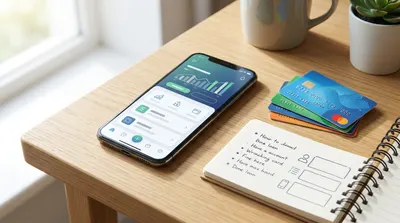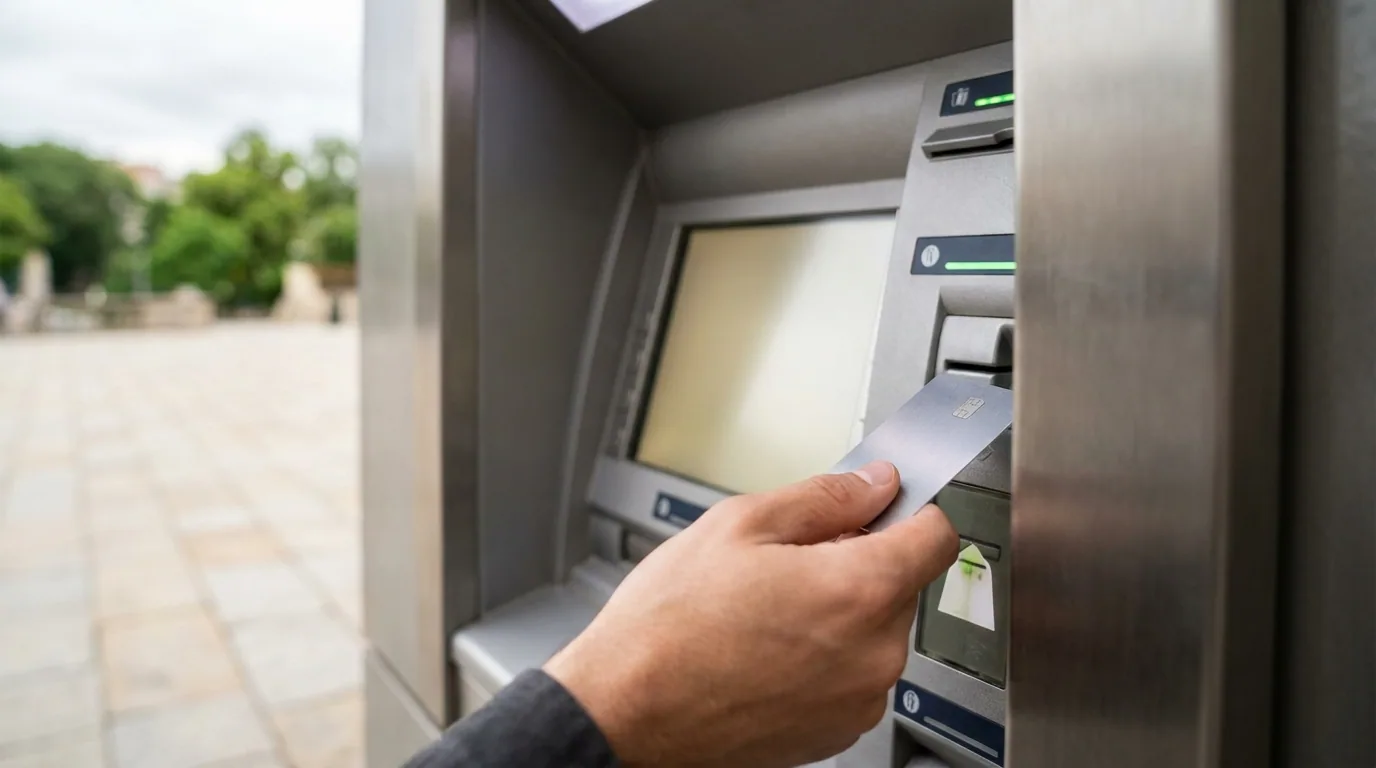
All seven accounts below give you a way to pull cash out of savings directly, without first moving money to a checking account: a debit card, an ATM card, or in one case paper checks. What differs is everything after that. UFB Direct's card works at more than 91,000 ATMs and then stops at $510 of cash a day.
Quontic hands you checks and a debit card, then charges $10 on every transaction past six in a statement cycle. Rates matter here, but so do the withdrawal caps, the transaction counts, and the conditions sitting behind the advertised number.
Cards on Savings Accounts Are Rare and Have to Be Requested
The request is most of the process: an accountholder asks for an ATM card, a debit card, or a checkbook tied to the savings balance, typically once the account is already open, and the bank issues it at no charge. It doesn't turn up in the welcome materials on its own.
Most savings accounts don't include one at all, and the reason is friction the bank keeps on purpose. Money set aside in savings is supposed to sit slightly out of reach, and a card removes that. Each card in circulation is also one more credential someone can misuse.
Without one, spending from savings means moving the balance to checking first, or walking into a branch for cash. Online-only banks have no branches, so the transfer is the only route.
What the card buys is cash on the day you need it instead of a transfer planned two days ahead.
What the Seven Accounts Offer, Pay, and Limit
| Account | Cash access | Advertised APY | One limit to know |
|---|---|---|---|
| Quontic Bank Money Market | Debit card and checks | 4.25% (as of 11/03/25) | $10 fee on each transaction over six per statement cycle |
| Happen Bank LevelUp Savings | ATM card | Up to 4.00% | Needs $250 in deposits per evaluation period |
| SoFi Checking and Savings | Debit card | Up to 3.80% for up to 6 months | Best rate requires eligible direct deposit |
| Synchrony Bank High Yield Savings | ATM card | 3.30% on all balances | $1,000 daily ATM withdrawal limit |
| UFB Portfolio Savings | ATM card | Up to 3.26% | $510 daily cash withdrawal limit for ATM cards |
| Alliant High-Rate Savings | ATM card | 3.01% | $100 average daily balance to earn dividends |
| Citi Savings | ATM card | Up to 1.05% APY (as of 07/28/26) | APY set by rate region and relationship tier |
All of these rates are variable, which means the bank can change them after your account is open. None of them is locked for a term.
Checks and a Debit Card at Quontic, Capped at Six Transactions a Cycle
Money market accounts sit between savings and checking, and the Quontic Bank Money Market Account is the one on this list that offers both a debit card and check-writing.
It pays 4.25% APY (as of 11/03/25) and takes a $100 minimum opening deposit, which is lower than many money market accounts ask for.
The catch is a transaction count. Quontic charges a $10.00 excess transaction fee for every transaction beyond six per account statement cycle, and the six include preauthorized withdrawals, automatic or telephonic transfers, checks, drafts, and debit card transactions.
That adds up faster than it sounds. Say you write one check to a contractor, run two debit card purchases, and have three automatic transfers scheduled.
That's six, and anything else that month carries the fee. Fee-free ATM access runs through about 90,000 machines in the AllPoint, MoneyPass, SUM, and Citibank networks.
Synchrony Refunds up to $5 a Month in Out-of-Network ATM Fees
Synchrony Bank High Yield Savings pays 3.30% APY on all balances, with no monthly fee and no minimum balance to earn interest. The rate doesn't shift with your balance or your activity, which is what makes it the simplest account here to hold.
Its cash access comes through an ATM card that works in the Plus and Accel networks, more than 400,000 machines between them. Synchrony also reimburses up to $5 per month in ATM fees charged by out-of-network operators, a feature none of the other accounts on this list matches.
The daily ATM withdrawal limit is $1,000, and the reimbursement is capped, so heavy out-of-network use can still cost you.
UFB Portfolio Savings Reaches 91,000 ATMs but Caps Cash at $510 a Day
UFB Direct, a division of Axos Bank, pays up to 3.26% APY (accurate as of 01/06/2026) on the UFB Portfolio Savings account. It's a tiered variable rate, there's no monthly fee, and there's no minimum deposit or balance requirement.
The draw is reach. UFB has no ATMs of its own, but the card works fee-free at more than 91,000 machines nationwide through the Allpoint network, including ATMs inside CVS and Walgreens, Target, and gas stations.
There's no cap on how many funds transfers you can make in a month, and you can deposit cash at ATMs that accept it.
The limit is on cash out: $510 per day for ATM cards. For someone who occasionally needs a few hundred dollars, that's fine. For a cash-heavy purchase, it means multiple days of withdrawals.
UFB also changes account names and features fairly often, so the product you open may not carry the same label a year later.
SoFi Pays Up to 3.80% for Six Months, With Direct Deposit Attached
SoFi Checking and Savings is one of the few accounts that puts a true debit card on the savings side, because the checking and savings functions are bundled into a single account. There's no separate savings account to transfer into.
The rate structure has several layers:
- Up to 3.10% APY on savings with eligible direct deposit, or 1.00% APY without it (as of 5/28/26)
- A 0.70% APY Boost added to the 3.10% APY, for up to 6 months, bringing the total to up to 3.80% APY on new Checking and Savings accounts opened with eligible direct deposit by 12/31/26
- No minimum balance requirement for the APY
There's also a cash bonus for members who haven't previously enrolled in direct deposit with SoFi: $50 with at least $1,000 in total eligible direct deposits received within 25 calendar days of the first eligible direct deposit of $1 or more, or $400 with at least $5,000 in that same window. The promotion runs from 5/15/2026 through 12/31/26.
Other details: no account, overdraft, or monthly fees; direct deposit funds can arrive up to two days early; and the debit card works at more than 55,000 Allpoint ATMs.
SoFi Bank is a Member FDIC and doesn't provide more than $250,000 of FDIC insurance per depositor per legal category of account ownership, though deposits may be insured up to $3 million through the SoFi Insured Deposit Program.
What SoFi wants in exchange for the top rate is a routed paycheck, a condition more common on checking accounts than on savings. The terms put no dollar floor under the deposit itself. The account simply has to be receiving one.
Happen Bank's 4.00% Rate Resets Every Statement Cycle
Happen Bank LevelUp Savings pays a LevelUp Rate of 4.00% APY (accurate as of 01/13/2025) or a Standard Rate of 3.00% APY (same date), and which one you get is re-decided regularly.
The LevelUp Rate applies to the full balance when the account receives at least $250 in deposits during an evaluation period. Fall short, and the account earns the Standard Rate.
An evaluation period is a statement cycle. New accounts start on the LevelUp Rate and keep it until the first evaluation period, which is the third statement cycle after opening, with any rate change taking effect the following cycle.
Interest payments, bonuses, credits, and refunds from the bank don't count as deposits for this test.
Cash access is through an ATM card, which sits alongside the deposit test for anyone moving cash in and out regularly.
Alliant's 3.01% Dividend Requires a $100 Average Daily Balance
Alliant High-Rate Savings pays a dividend equal to 3.01% APY, accurate as of the 02/01/2026 dividend declaration date.
Dividends are paid on the last day of the month to accountholders who kept an average daily balance of $100 or more, and the dividend applies across several Alliant account types, including Supplemental Savings, Emergency Savings, Kids Savings, UTMA custodial, trust, and IRA accounts.
Cash access runs through an ATM card. Credit unions are member-owned, so eligibility rules and share insurance work differently than at a bank. Worth reading before assuming the account behaves like the online banks above.
Citi's Savings Rate Depends on Where You Live and What Else You Hold
Citi Savings is the branch-banking entry here, and it's also the hardest to pin down. The account carries a 3.75% promotion interest rate, with an APY of up to 1.05% (as of 07/28/26).
Citi sets savings rates at its discretion, and the APY you're offered is determined by rate region, relationship tier, and any applicable promotion.
In plain terms: two people can open the same Citi savings account in different ZIP codes, with different balances elsewhere at the bank, and earn different rates.
Cash access is through an ATM card, with branches available for in-person withdrawals.
Daily Caps, Transaction Counts, and Out-of-Network Surcharges
Three separate limits show up across these accounts, and they stack.
- Daily cash limits: $510 at UFB, $1,000 at Synchrony. Neither is unusual for an ATM card, but both are lower than many people assume.
- Transaction counts. Quontic's six-per-cycle rule, with a $10.00 fee after that, applies to checks, debit purchases, and automatic transfers together.
- ATM operator surcharges. In-network ATMs are free at every account here, but out of network the machine's owner can add its own fee, separate from anything your bank charges. Synchrony's $5 monthly reimbursement is designed for exactly that, and it's capped.
One more practical point: not every ATM in a network accepts cash deposits, even when it dispenses cash. If depositing physical cash is part of why the card appeals to you, that's a feature to confirm machine by machine rather than network-wide.
Spending Accounts, Occasional-Cash Accounts, and Conditional Rates
Quontic and SoFi are the two you can spend from directly: Quontic through checks and a debit card, with a transaction ceiling attached, and SoFi through a combined checking-and-savings structure that expects a paycheck.
Synchrony, UFB, and Alliant are ATM-card accounts for occasional cash pickups, with Synchrony asking the least of you and UFB reaching the most places.
Happen Bank and Citi both tie the number they advertise to something you have to keep doing or something you can't control at all.
Rates are what get compared before an account is opened. A daily cash limit or a transaction count only becomes visible later, at the machine or on the statement.