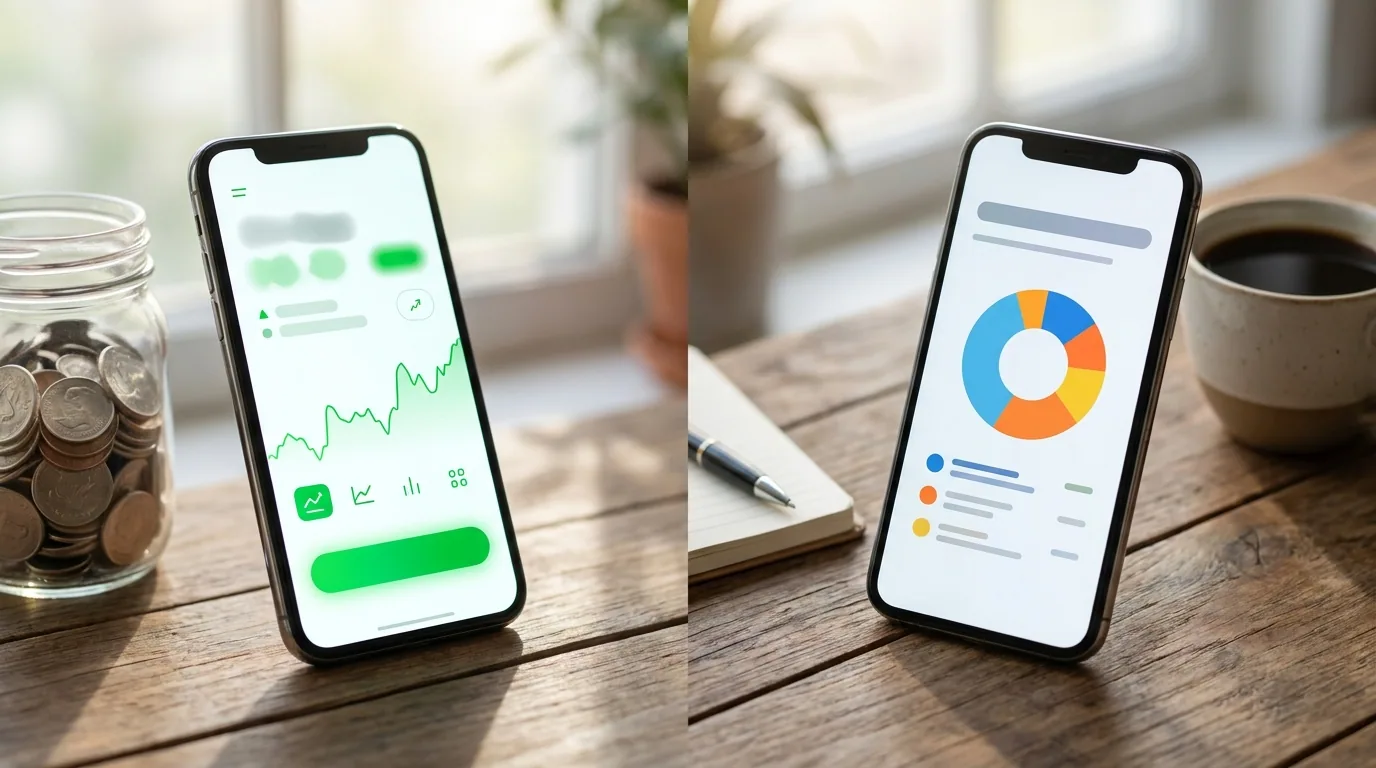
Acorns asks a handful of questions, recommends a mix of ETFs, and then funds the account with the change rounded up from your card purchases. Robinhood leaves every holding to you. Both fit on a phone screen and both let you start with a few dollars, which is roughly where the similarity ends.
Who Chooses the Investments
Robinhood works like a streamlined brokerage account. You browse, you decide, you place the trade. Nothing gets bought unless you buy it, which means the platform rewards some knowledge of how markets and individual assets work.
Acorns hands that decision back the other way. You answer questions about your goals, the app builds an ETF portfolio to match, and it does the buying. Individual stocks, options and crypto aren't available there at all.
Fees, account types and banking add-ons all follow from that one difference. Hands-on investors and hands-off investors are being sold two different products.
Monthly Fees, Minimums and What Each Account Can Hold
| Robinhood | Acorns | |
|---|---|---|
| Minimum investment | $1 | $5 |
| Management fees | None | $3, $6 or $12 per month |
| Asset classes | Stocks and funds, options, cryptocurrency | ETFs |
| Retirement accounts | Traditional and Roth IRA | Traditional, Roth and SEP IRA |
| Custodial accounts | Not offered | Offered |
| Margin trading | Available with Robinhood Gold | Not offered |
| Best suited to | Active investors | Hands-off investors |
Stock, ETF, options and crypto orders carry no commission at Robinhood, and the account itself opens without a deposit requirement. A paid tier, Robinhood Gold, costs $5 per month and adds margin eligibility, higher limits and Level II market data.
Gold also carries a match of up to 3% on IRA contributions. Acorns runs on a flat subscription instead: $3, $6 or $12 a month depending on the plan.
A flat monthly fee doesn't shrink relative to your balance the way a percentage-based fee does, so on a very small account it takes a larger share of the money invested than it will once the balance grows.
Robinhood's Asset List Against Acorns' ETF Portfolios
On Robinhood you can hold stocks, ETFs, options and cryptocurrency. The crypto side covers 18 coins, including Bitcoin, Ether and Cardano. Whatever a user buys can sit in the app or move out to a wallet held elsewhere, and coins sent in from another platform are accepted.
The orders themselves go in at the market price, or with a limit or stop attached. Fractional shares matter more than the name suggests.
Because you can buy a slice of a share instead of the whole thing, the sticker price on any one stock stops deciding whether you can own a piece of it. Robinhood also offers instant deposits, curated lists of popular stocks, and educational material for people still learning the mechanics.
Acorns keeps things narrower on purpose. Its recommended portfolios are built from ETFs covering areas such as real estate, government bonds, large companies, small companies, emerging markets and corporate bonds. That list is the whole menu; there's nothing to add to it.
Round-Ups, Rebalancing and Dividend Reinvesting Run on Their Own
The round-up feature is what Acorns is known for. Link a credit or debit card, and purchases get rounded up to the nearest dollar, with the difference moved into your investment account. Buy a coffee and a sandwich on the way to work, and the odd cents left over become an investment you didn't have to think about.
The automation goes further than that. Once the account is set up, Acorns invests on whatever recurring schedule you pick, rebalances the portfolio and puts dividends back to work without being asked, and partner offers, more than 10,000 of them, can add bonus investments on top.
None of that requires you to log in and act. That's the trade Acorns offers: less control in exchange for less effort.
Margin Trading Requires Robinhood Gold and $2,000 in the Account
Margin investing exists on the Robinhood side only. Borrowing against the account lets an investor hold more securities than the cash balance alone would cover.
Robinhood gates it three ways: the account has to be on a Gold subscription, the margin application has to clear, and the balance has to sit at $2,000 or more. Borrowing to invest cuts both ways.
The same leverage that magnifies a gain magnifies a loss, and the borrowed amount is owed regardless of how the position performs. It's a feature aimed at experienced investors, and Acorns has no equivalent.
Custodial Accounts That Transfer at 18, Plus Mighty Oak Checking
The rest of what Acorns offers sits outside the portfolio entirely. Start with custodial accounts, which Robinhood does not have.
An adult opens and funds the account for a child, invests on their behalf, and the child takes control at 18. Friends and relatives can add gift contributions. Acorns Early, the custodial feature, is included with Acorns Gold.
One piece of background catches parents out: money placed in a custodial account is generally treated as the child's property, so it isn't a pot you can reclaim for household use later. It also becomes theirs to direct once control transfers. Acorns Early sits in the same app as the taxable account and the IRA, under one login and the same automatic settings.
Acorns also pairs investing with a checking product, which is where the two apps stop resembling each other.
Mighty Oak Checking pays 2.18% (as of 12/11/25) APY and the Mighty Oak Emergency Fund pays 3.35% (as of 12/11/25) APY, with no account fees, and the automation carries over to the spending side: a piece of every paycheck goes into investments, spare change from purchases does too, and pay can land up to two days early. The debit card is tungsten metal.
Robinhood's spending-side offering is the Robinhood Cash Card, but the platform's center of gravity stays on investing.
IRAs, Learning Libraries and Account Insurance
For all their differences, the two overlap in a few places:
- Robinhood offers traditional and Roth IRAs. Acorns offers traditional, Roth and SEP IRAs, the last of which is aimed at self-employed savers.
- Both keep educational libraries covering investing and personal finance basics.
- Both were designed for people put off by the complexity of a standard brokerage interface.
On safety, Acorns is protected by the Securities Investor Protection Corp., and Acorns Spend is FDIC-insured, meaning federal backing up to certain limits if the company fails. That's separate from any protection against investment losses.
Withdrawal Limits and How Gains Get Taxed
Robinhood allows withdrawals of up to $50,000 per day straight to a linked bank account. With Acorns, you can transfer to a linked account or take cash out at an ATM.
Tax treatment is largely the same on the taxable side: dividends are taxable, and gains are taxed when you sell. Inside an IRA, that annual treatment doesn't apply, though IRA withdrawals can trigger early distribution penalties before age 59 1/2.
Anyone in an automated ETF portfolio should also know that selling to move platforms is itself a taxable event in a regular account, a cost that appears on no fee schedule.
Who Does the Work, and What It Costs
The subscription is the sharpest line between the two. Acorns bills $3, $6 or $12 a month whether or not you open the app, and a fair part of what that buys is not having to open it: round-ups, recurring transfers, rebalancing and dividend reinvestment all keep running unattended. Robinhood bills nothing monthly unless you add Gold, and nothing moves in the account until someone places an order.
Investment risk sits on both sides, and no app design removes it. What the pricing settles is narrower: how much of the account's routine work gets handled for you, and what a flat monthly charge for that work comes to as a share of whatever balance it's charged on.