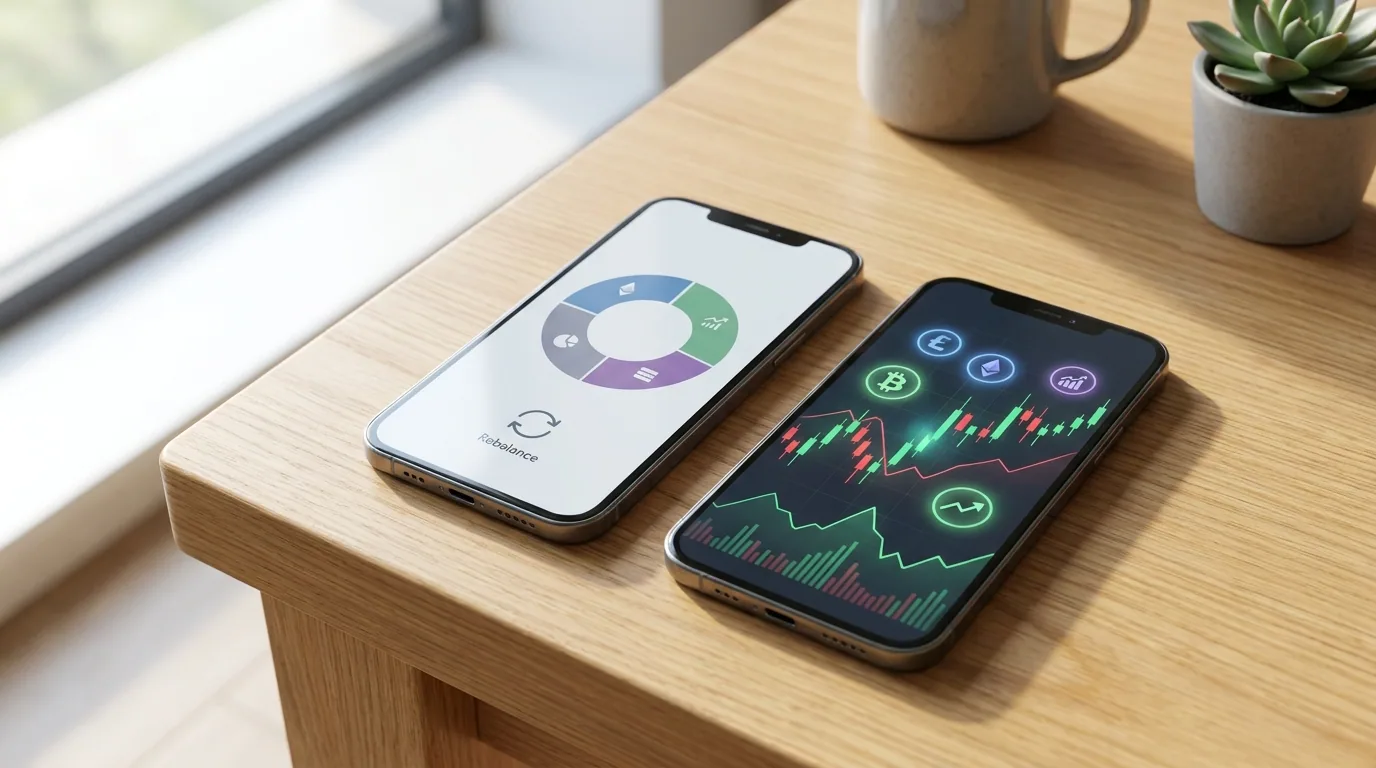
M1 Finance places trades in two windows each day, one in the morning and one in the afternoon. Robinhood advertises buying and selling stocks 24 hours a day, five days a week.
The two apps were built for different investors, and most of the other differences between them fall in line behind that one.
Two Daily Windows on M1, 24/5 Trading on Robinhood
M1 is built around automation. You set up a portfolio using what M1 calls a "Pie," a visual container split into slices, with each slice representing a holding and a target weight.
You can build the Pie yourself or start from a professionally designed one, and the platform handles rebalancing back toward your targets from there. Orders don't go out the moment you tap the button; they're executed in M1's morning or afternoon window.
Robinhood works the other way around. Portfolio decisions and upkeep stay with the account holder, and an order goes out when it's placed.
The trade-off is direct: Robinhood gives you timing control and live market monitoring, while M1 gives you a portfolio that keeps its own shape without you logging in.
Say news breaks at 11 a.m. and you want out of a position immediately. Robinhood lets you act on it. On M1, that order waits for the next window.
For someone contributing a fixed amount every month toward a long-term allocation, the wait is irrelevant. For someone trading on the day's headlines, it's the difference that matters most.
Commissions, Crypto Fees, and the Two Subscriptions
Neither app charges commissions on stock and ETF trades, but "commission-free" isn't the same as "free."
| Cost | M1 | Robinhood |
|---|---|---|
| Stocks and ETFs | $0 | $0 |
| Crypto | 1% | 0.03%-0.85% |
| Options | Not offered | $0 |
| Margin trading | 5.65% | 3.95%-5% |
| Subscription | $3/month, waived with a balance of $10,000 or more at least during your billing cycle, or with an M1 personal loan | None for a basic account; $5/month for Robinhood Gold |
The subscription lines matter more than they look. Several of Robinhood's headline features, including the higher cash rate, the IRA contribution match, and banking access, sit behind Gold. On the M1 side, the $3 monthly fee is the thing a smaller balance feels most.
$100 and $500 Minimums on M1, None on Robinhood
M1 asks for $100 to open a taxable account and $500 for a retirement account. Robinhood has no account minimum, except for margin accounts, which require $2,000. For someone starting with a small first deposit, that's a real gate on one side and none on the other.
Robinhood Carries Options, Futures, and More Crypto
Both platforms cover stocks, ETFs, and cryptocurrency. Only Robinhood offers options, futures, and American Depositary Receipts.
Crypto is where the menus diverge most: 14 coins on M1 against over 60 on Robinhood. Fees run the other way, though. M1 charges 1% on crypto, Robinhood 0.03%-0.85%.
M1 Opens SEP IRAs and Trust Accounts
Both offer standard brokerage and retirement accounts. M1 adds two that Robinhood doesn't: SEP IRAs and trust accounts. For self-employed savers and anyone investing through a trust, that's the difference between the two.
Joint brokerage accounts used to be an M1 advantage. Robinhood introduced them in July 2024, so the two now match on that.
Robinhood's retirement pitch runs through its subscription instead. Gold members can get up to a 3% match on IRA contributions.
Fractional Shares Bring Down the Entry Price on Both
Both platforms support fractional shares, so a position can be bought in dollar amounts instead of whole shares.
M1 allows fractional shares of stocks and ETFs. Robinhood applies it across a broader set of investments and pairs it with no account minimum, which is the more forgiving combination when you're working with small amounts.
Cash Accounts: M1's Rate Comes Without a Subscription
Both platforms park uninvested cash in an interest-bearing account so money can move between spending and investing without leaving the platform.
- M1 High-Yield Cash Account earns up to 3.60% (as of 09/01/25). It's available as an individual or joint account.
- Robinhood's cash sweep earns up to 3.35% (as of 02/11/26) APY, but requires a Robinhood Gold plan at $5 per month.
The rate tables leave out something worth knowing: cash account yields are variable and reset as rates move, so the figure you see at signup is a snapshot, not a term. Robinhood's own disclosure also points out that if you carry a margin balance, there's no cash balance left to earn interest.
M1 no longer issues a debit card, and no replacement is planned.
Margin Loans on Both, at Different Rates
M1 discontinued its credit card in 2025. What remains is a Margin Loan, a line of credit sized against the value of your brokerage account and repaid with interest.
It's available if you hold at least $2,000 in an M1 Brokerage or Trust account. No credit check runs on the application, and the repayment schedule is flexible.
As for how fast the money shows up: minutes if it's going into an M1 Spend or Invest account, several business days if it's headed to an outside bank.
Robinhood also offers margin borrowing, at 3.95%-5% versus M1's 5.65%, with that $2,000 minimum on margin accounts.
A portfolio-backed loan is secured by the investments themselves. If those holdings fall in value, the collateral behind the loan shrinks, and brokerages can require more cash or sell positions to cover the shortfall.
No credit check is required because the portfolio is what secures the loan, and the portfolio can be sold.
Robinhood Banking Is Bundled Into the Gold Subscription
Gold members can request access to Robinhood Banking, which includes checking and high-yield savings accounts. The entry cost is the $5 monthly Gold subscription rather than a large balance requirement. Savings can earn 3.50% (as of 01/29/26) APY.
The rest of Banking comes with that same subscription rather than any added fee. Households can open separate accounts for a spouse or partner and for children.
Members who'd rather not find an ATM can request cash delivery on demand. And for people who travel, Robinhood attaches perks: chauffeurs, hotel experiences, helicopter rides.
Neither Platform Offers Tax-Loss Harvesting or Human Advice
This is the shared gap, and it's the one that pushes investors with larger or more complicated portfolios elsewhere. Neither app provides automated tax-loss harvesting, and neither puts a human advisor on the other end of the line.
M1's automation has a tax wrinkle of its own. Rebalancing inside a taxable account can involve selling, and sales in a taxable account can create reportable gains or losses. Inside an IRA, that mechanic doesn't apply the same way.
How Each App Makes Money
The revenue models overlap almost completely, which is worth knowing when you're weighing "free" trading:
- M1: payment for order flow, the platform fee, lending out shares held in customer accounts, interest charged on customer margin balances, and interest earned on customer cash.
- Robinhood: payment for order flow, Gold subscriptions, interest charged on customer margin balances, and interest earned on customer cash.
Which Investor Each One Suits
These two apps aren't competing for the same person. M1 fits an investor who wants to choose an allocation once, automate the upkeep, and hold a wider range of account types, including a SEP IRA or a trust, while accepting fixed trading windows, no options or futures, and a narrower crypto menu.
Robinhood fits an investor who wants to press the button, in real time, across a wider asset menu, with no minimum standing in the way.
Its best rates and perks come attached to a $5 monthly subscription, so the value of Gold depends on whether you'd actually use the cash account, IRA match, and banking features.
All investing carries the risk of losing money. Rates, fees, and product lineups change on both platforms too, and the discontinued M1 cards are a reminder of how quickly a feature list can shift.