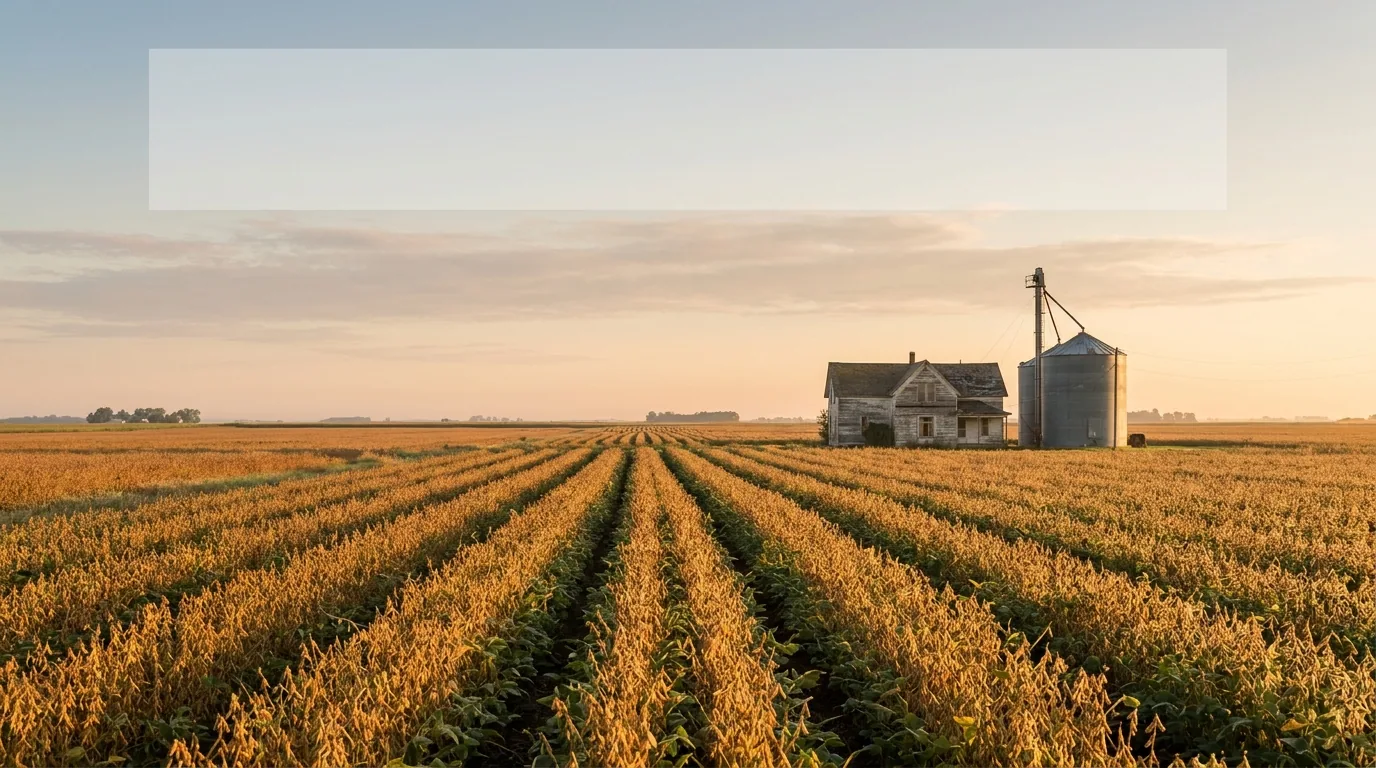
Roughly 40% of U.S. farm acreage is rented rather than worked by whoever owns it. That rented share is the door farmland comes through into an investment portfolio, since the landlords collecting the rent are largely people and entities with no hand in the farming, investment groups among them.
Owner-operators held the remaining 60% as of the 2017 Census of Agriculture. For scale, the Department of Agriculture counts almost 900 million acres of farmland spread across more than 2 million farms.
Where Farmland Returns Come From
Farmland pays in a few separate ways, and which ones apply depends on how the investment is held.
- Rent. A tenant farmer pays for the use of the ground, and for a landlord that's the recurring piece.
- Land value appreciation. Farm real estate values have historically risen over time, so cropland or pastureland bought now may be worth more when it's sold later.
- Income from what the land produces. Investors who farm their own acreage can also earn from selling crops, or from livestock grazing the land.
Stacking rent on top of a possible sale later is the classic buy-and-hold case. None of it is assured. Land values can move against an owner, and a vacant parcel pays no rent.
REITs and Agriculture ETFs, Open to Any Investor
The simplest entry point doesn't involve land at all. Two publicly traded companies focus on owning and leasing farmland:
- Farmland Partners (FPI), a real estate investment trust listed on the New York Stock Exchange. The company describes its aim as acquiring high-quality farmland across North America to serve global demand for food, feed, fiber, and fuel.
- Gladstone Land Corp (LAND), a real estate company trading on the NASDAQ, whose main business is owning farmland and leasing it out.
Both trade like any other stock. Exchange-traded funds are another route, though most agriculture ETFs hold agribusiness companies rather than farmland itself; the VanEck Agribusiness ETF (MOO) and the Teucrium Soybean ETF (SOYB) are two examples.
Farmland Partners itself appears as a holding inside 25 ETFs, by one industry count, so plenty of funds carry a slice of farmland exposure without being farmland funds.
Publicly traded REITs, ETFs, and mutual funds in this space are available to anyone, and their minimums tend to be low compared with private options.
Worth keeping in mind, though: a listed REIT's share price moves with the stock market's mood as much as with the value of the dirt the company owns. That's a different experience from holding a deed.
Crowdfunding Platforms and Private Funds Usually Require Accredited Investors
Between the stock market and a land purchase sits a middle tier of pooled vehicles that buy specific farms and sell investors a share.
FarmTogether, for instance, is a fintech platform offering accredited investors shares in agricultural land: farms, orchards, and other farmland properties.
Investors pick which properties to back and can hold fractional shares or entire parcels, through account types including individual accounts and self-directed IRAs.
Other farmland crowdfunding and private-equity style platforms include AcreTrader, FarmFundr, Farmland LP, Harvest Returns, and Steward.
Two constraints define this tier. Access is generally limited to accredited investors who meet government income and asset requirements, and minimum investments run higher than for publicly traded funds.
Investors also tend to be buying into a named farm rather than a diversified basket, which concentrates the outcome on one property's weather, water, and tenant.
Three Ways to Own Physical Farmland and Lease It Out
For buyers who want the deed, the practical question is how the land gets tenanted.
| Approach | What it involves | Trade-off |
|---|---|---|
| Buy and rent | Purchase existing farmland, then find and vet a new tenant farmer | More legwork: checking the farmer's experience and other operations |
| Sale-leaseback | Buy from the farmer already working the land and lease it back | Rent can begin almost as soon as the deal closes, and the purchase price tends to reflect that |
| Convert land | Acquire non-farm land and turn it to agricultural use | The riskiest of the three: permits, physical work, and finding tenants |
A sale-leaseback is the version investors with lower risk tolerance often prefer, because nothing about the farming operation changes on closing day.
Picture a grower who wants capital out of the ground but intends to keep planting it: the investor buys the parcel, the grower keeps working it as a tenant, and rent begins against an operation that already has an income stream. The price paid usually reflects that convenience.
Conversion sits at the other end. Turning raw or previously developed ground into pasture, row crops, or urban farming can mean permits and real physical work before any tenant arrives, which is why purchase price matters so much in that scenario.
Farmland's Volatility Has Run Closer to Bonds Than to Stocks
Volatility measures how much a price swings over time. From 1992 through 2020, a farmland index showed 6.9% volatility. Over the same stretch:
| Asset | Volatility, 1992–2020 |
|---|---|
| Farmland index | 6.9% |
| S&P 500 | 17.15% |
| U.S. bonds | 4.55% |
On that measure, farmland behaved much more like bonds than like large-cap stocks. Low volatility isn't the same thing as low risk, since an illiquid asset can simply be priced less often, but it explains why farmland comes up as a portfolio diversifier.
The Inflation-Hedge Argument Rests on a Fixed Supply of Land
Investors often treat real estate as a hedge against inflation, meaning they expect returns from it to hold up as prices rise, and one reason usually given is that the amount of land in existence doesn't grow.
Farmland carries an extra wrinkle. Global population keeps growing, so food demand rises, while suburban and exurban development keeps converting farm acreage into subdivisions.
Between 1960 and 2012 there were many years in which farmland held its value against inflation better than gold did.
Selling Farmland, and Lock-Ups in Private Funds
No type of real estate offers daily liquidity the way stocks, bonds, ETFs, or mutual funds do. With physical farmland, converting the asset to cash means finding a buyer.
How long that takes depends on local supply and demand, and on the specific qualities of the parcel: a few weeks, or considerably longer.
Private vehicles have their own version of the problem. Crowdfunding platforms, private equity farmland funds, and similar pooled investments often impose lock-up periods, stretches during which money simply can't be withdrawn.
The exceptions on the liquidity front are real estate mutual funds and ETFs, and in some cases publicly traded REITs, which can be sold on an exchange during market hours.
An owner also carries ongoing costs between purchase and sale, property taxes and upkeep among them, and those don't pause while a buyer is being found.
Active Versus Passive Participation Changes the Tax Treatment
Farmland can be worked or simply owned, and the same parcel can be both: an investor might farm part of it and lease the rest to a farmer, another investor, or a developer.
The distinction has tax consequences. The IRS separates active from passive investors and sets out how much hands-on involvement in the operation, and how consistently, an owner needs before it counts as material participation.
Those definitions drive how the income is taxed. Because the line depends on facts specific to each situation, it's an area commonly reviewed with a tax professional who works with farm or real estate income.
Pricing Land and Vetting Tenants Takes Specialist Knowledge
Direct purchases rely on judgments most investors can't make unaided: what a parcel is genuinely worth, what it can grow, and what a tenant should be paying.
Soil quality, drainage, irrigation access, and water rights can separate two neighboring parcels with similar asking prices. Tenant selection matters too, since a landlord's rent depends on the operator's experience and on how their other farming ventures are going.
Liquidity, Minimums, and Control Across the Three Routes
The route matters more than the asset class. Listed REITs and agriculture ETFs put farmland exposure within reach of small investors, with daily liquidity and stock-market price swings attached.
Move up a tier and crowdfunding platforms and private funds tie the money to specific farms, but gate entry behind accredited-investor rules, larger minimums, and lock-ups.
Direct ownership offers the most control and asks for the most capital, patience, and specialist knowledge, plus the acceptance that the money stays put until a buyer turns up.
The 6.9% volatility figure and the fixed-supply argument describe the land itself; how much of either reaches an investor depends on which of these wrappers is holding it.