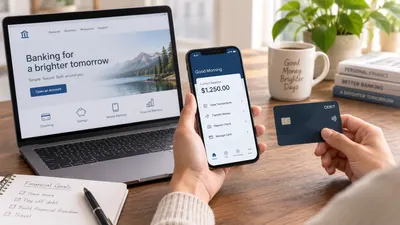
Learning how to choose a bank starts with understanding how you actually handle money. A nearby branch can matter if you regularly deposit cash, while strong mobile tools may matter far more if nearly every transaction happens online. Fees, interest rates, ATM availability, minimum balances, customer support, and deposit insurance can also affect the value you receive.
Rather than picking an institution because its name is familiar, compare the account terms with your regular banking habits. A little research before opening an account may help you avoid fees or account restrictions that become frustrating later.
How to Choose a Bank: Start With Your Banking Habits
Before comparing institutions, list the banking tasks you perform regularly.
Ask yourself:
- Do you receive your paycheck through direct deposit?
- Do you regularly deposit cash?
- How frequently do you use ATMs?
- Do you want access to physical branches?
- Do you keep a large balance in savings?
- Do you need paper checks?
- Do you frequently transfer money between institutions?
- Do you depend on mobile banking?
- Do you want checking and savings at the same institution?
- How important is phone or in-person customer service?
Your answers can narrow the field quickly.
For example, someone who regularly handles cash may place greater value on branches or cash-deposit ATMs. Someone paid entirely by direct deposit may find branch access far less important.
The best bank for your needs depends on how well the institution's account terms match these habits rather than one feature alone.
1. Compare Monthly Fees Before Interest Rates
Start with recurring costs. An attractive savings rate can lose some of its financial benefit if you regularly pay maintenance charges.
The Consumer Financial Protection Bureau states that banks and credit unions may charge monthly maintenance fees. Some institutions waive these charges when customers meet requirements such as maintaining a specified balance or receiving qualifying direct deposits. Financial institutions must disclose these fees when an account is opened.
When comparing bank account fees, check for:
- Monthly maintenance charges
- Minimum-balance requirements
- Out-of-network ATM charges
- Overdraft charges
- Wire transfer fees
- Stop-payment charges
- Check fees
- Returned-payment charges
- Account inactivity charges
Even an account advertised as "free" deserves a closer reading. According to the CFPB, a free checking account cannot carry a monthly service charge or a fee for failing to maintain a minimum balance. Certain other charges, including ATM, overdraft, bounced-check, stop-payment, and check-printing fees, can still apply.
Calculate the costs based on how you plan to use the account instead of focusing solely on the advertised monthly charge.
2. Check the Minimum Balance Requirements
Some accounts require a certain opening deposit. Others require you to maintain a specified balance to avoid a monthly charge or qualify for certain benefits.
For example, an account with a monthly fee that disappears after maintaining a qualifying balance could work well if your normal balance comfortably exceeds that requirement.
It may be less practical if meeting the requirement forces you to keep money in checking that you would prefer to place in an interest-earning savings account.
Look separately at:
- Minimum opening deposit
- Minimum daily balance
- Average monthly balance
- Direct-deposit requirements
- Balance needed to waive monthly charges
- Balance needed to receive an advertised interest rate
Read the account disclosures carefully because these conditions can differ even between accounts at the same institution.
3. Compare Savings APYs
Interest becomes increasingly relevant as your savings balance grows.
Annual percentage yield, or APY, reflects the interest earned over a year while accounting for compounding. A higher APY generally produces higher interest earnings when the balance and other conditions are equal.
Still, avoid evaluating a savings account solely by its advertised percentage.
Check:
- Current APY
- Balance needed to receive that APY
- Any deposit requirements
- Rate tiers
- Promotional expiration dates
- Monthly charges
- Withdrawal policies
Savings rates are commonly variable, so a rate available when you open an account may change later.
If saving is one of your main goals, periodically checking your rate against competing accounts can help you see if the account remains competitive.
4. Compare Online Banks and Branch-Based Banks
The online bank vs traditional bank decision often comes down to access.
An online institution may suit you if you handle deposits electronically and rarely need in-person assistance. A branch-based institution may be easier if you frequently deposit cash or want face-to-face service.
Here is a practical comparison:
| Feature | Online Bank | Branch-Based Bank |
|---|---|---|
| Physical locations | Usually limited or unavailable | Common |
| Cash deposits | May be limited | Typically easier |
| Mobile banking | Usually a major service channel | Commonly available |
| In-person assistance | Usually unavailable | Available at branches |
| ATM availability | Depends on network | Depends on bank and network |
| Interest rates | Vary by institution | Vary by institution |
| Account fees | Vary by account | Vary by account |
Neither model automatically provides better terms. Compare the actual account rather than assuming all digital institutions or branch-based institutions operate alike.
5. Check ATM Access and Cash Deposit Options
ATM access deserves extra attention if you regularly withdraw cash.
Using an ATM outside your institution's network can potentially result in two charges: one from your bank or credit union and another from the ATM operator. The CFPB confirms that both parties may charge a fee.
Before opening an account, check:
- Number of fee-free ATMs
- Locations near your home or workplace
- Out-of-network ATM charges
- ATM fee reimbursements, if available
- Daily withdrawal limits
- Cash deposit capabilities
A large ATM network can be especially useful if you travel frequently or live far from a physical branch.
6. Verify Deposit Insurance
Before depositing money, confirm how your deposits are insured.
At an FDIC-insured bank, eligible deposit accounts receive automatic FDIC coverage. The standard insurance amount is $250,000 per depositor, per insured bank, for each account ownership category.
FDIC coverage applies to eligible deposit products such as checking accounts, savings accounts, money market deposit accounts, and certificates of deposit. Investments such as stocks, bonds, mutual funds, and crypto assets are not FDIC-insured deposits.
You can verify an institution using the FDIC's BankFind Suite, which allows consumers to search for currently insured banking institutions.
Credit unions have a separate federal insurance system. Federally insured credit unions receive coverage through the National Credit Union Share Insurance Fund, administered by the NCUA. Individual accounts generally receive coverage up to $250,000, with separate rules applying to joint, retirement, and trust accounts.
7. Review Checking and Savings Together
You may prefer keeping checking and savings accounts at one institution for convenience, yet separating them can sometimes provide access to better account terms.
Keeping both together may make transfers easier and reduce the number of apps and logins you manage.
Using separate institutions can make sense when one has a checking account suited to daily spending while another pays a higher savings rate.
Before deciding, compare:
- Transfer speeds
- Linked-account capabilities
- Savings APY
- Checking fees
- Direct-deposit features
- ATM access
- Mobile tools
Also check withdrawal policies for savings. The Federal Reserve removed the federal six-per-month limit on convenient savings transfers in 2020. Financial institutions can still maintain their own transaction policies, so the account agreement remains important.
8. Examine Overdraft Policies
Overdraft policies can make a significant difference if your checking balance occasionally runs low.
An overdraft occurs when there is not enough money in an account to cover a transaction and the financial institution pays it anyway.
Under federal rules, banks and credit unions cannot charge an overdraft fee for one-time debit-card purchases or ATM withdrawals unless you have opted into that coverage. Different rules can apply to checks and recurring electronic payments.
Ask each institution:
- Does the account allow overdrafts?
- What transactions can trigger charges?
- Can checking be linked to savings?
- Are insufficient transactions declined instead?
- Are low-balance alerts available?
- Can overdraft coverage be disabled?
Some institutions provide accounts designed to prevent spending beyond your available balance. These can reduce overdraft risk, although they may have limitations such as restricted check writing or bill-payment features.
9. Evaluate the Mobile App and Online Banking Tools
Digital features affect everyday usability even if your institution has hundreds of branches.
What to look for in a bank includes the tasks its website and mobile app let you complete without calling customer service.
Useful features may include:
- Mobile check deposit
- Account alerts
- Card locking and unlocking
- Electronic transfers
- Online bill payment
- Transaction search
- Digital statements
- Automatic savings transfers
- Budgeting features
- Customer support access
Check the institution's current app features directly because capabilities can change.
You may also want to read recent app reviews, paying particular attention to repeated complaints about login problems, deposit functionality, transfers, or customer support.
10. Look at Customer Service Availability
Customer service can seem secondary until a card stops working, a transfer gets delayed, or you spot an unfamiliar transaction.
Check how assistance is provided:
- Phone
- Secure messaging
- Live chat
- Physical branches
- In-app support
Then check the service hours.
A bank with 24-hour phone assistance may fit someone who travels or works outside standard business hours. Another person may prefer an institution with local branches where account issues can be discussed face to face.
11. Read the Account Disclosures Before Applying
Marketing pages highlight attractive features. Account disclosures explain the conditions attached to them.
Before applying, check the institution's:
- Fee schedule
- Deposit agreement
- Funds-availability policy
- Interest-rate disclosures
- Overdraft terms
- ATM policies
- Transfer limits
- Account-closing rules
Pay particular attention to promotional accounts. A bonus or elevated interest rate may require qualifying direct deposits, a minimum balance, a specific number of transactions, or keeping an account open for a defined period.
Knowing those conditions beforehand makes comparisons far easier.
A Simple Bank Comparison Checklist
Before opening an account, compare each institution using the same criteria.
| Factor | Questions to Ask |
|---|---|
| Monthly fee | Is there one, and can you avoid it? |
| Opening requirement | How much money must you deposit? |
| Minimum balance | Is one required to avoid charges? |
| Savings APY | What rate applies to your expected balance? |
| ATM network | Are fee-free ATMs convenient for you? |
| Cash deposits | How can physical cash be deposited? |
| Branches | Do you need in-person banking? |
| Mobile features | Can you handle regular banking tasks digitally? |
| Overdraft | What happens when your balance runs short? |
| Transfers | How can you move money to another institution? |
| Customer support | When and how can you reach someone? |
| Deposit insurance | Is the institution federally insured? |
Do not give every category equal weight automatically. Someone who never handles physical cash may care little about branch availability. Someone who deposits cash every week may rank it near the top.
Should You Use a Bank or Credit Union?
Both can provide checking, savings, and other financial services.
The right comparison depends on the individual institution and account. Review rates, fees, eligibility requirements, branch and ATM access, digital capabilities, and customer service before deciding.
Deposit protection should be verified as well. Banks can carry FDIC insurance, while federally insured credit unions receive NCUA-administered share insurance. Both systems generally provide $250,000 in standard coverage under their applicable rules.
Choosing a Bank Based on How You Actually Bank
Knowing how to choose a bank becomes easier once you stop looking for a single institution that excels at every possible feature.
Start with the services you use frequently. Then compare costs, account requirements, access, interest rates, digital tools, customer service, and deposit insurance.
Pay close attention to recurring fees because even a small monthly charge adds up over time. Check ATM availability if you use cash, compare APYs if you maintain savings, and verify federal deposit insurance before moving significant funds.
Finally, read the account agreement before applying. The headline rate or sign-up promotion may attract your attention, yet the everyday terms determine how well the account fits the way you manage money.