The effects of rising interest rates can influence how much you pay to borrow money, how much interest you earn on savings, and how you manage investments. When interest rates increase, monthly payments on certain loans may become expensive, while some savings products may provide higher returns.
Understanding these changes can help you review your financial decisions before applying for a mortgage, financing a vehicle, carrying credit card debt, or selecting a savings account.
However, higher interest rates do not affect every financial product in the same way. Your results depend on the type of account, whether your borrowing rate is fixed or variable, and how financial institutions respond to changing economic conditions.
What Are the Effects of Rising Interest Rates on Your Finances?
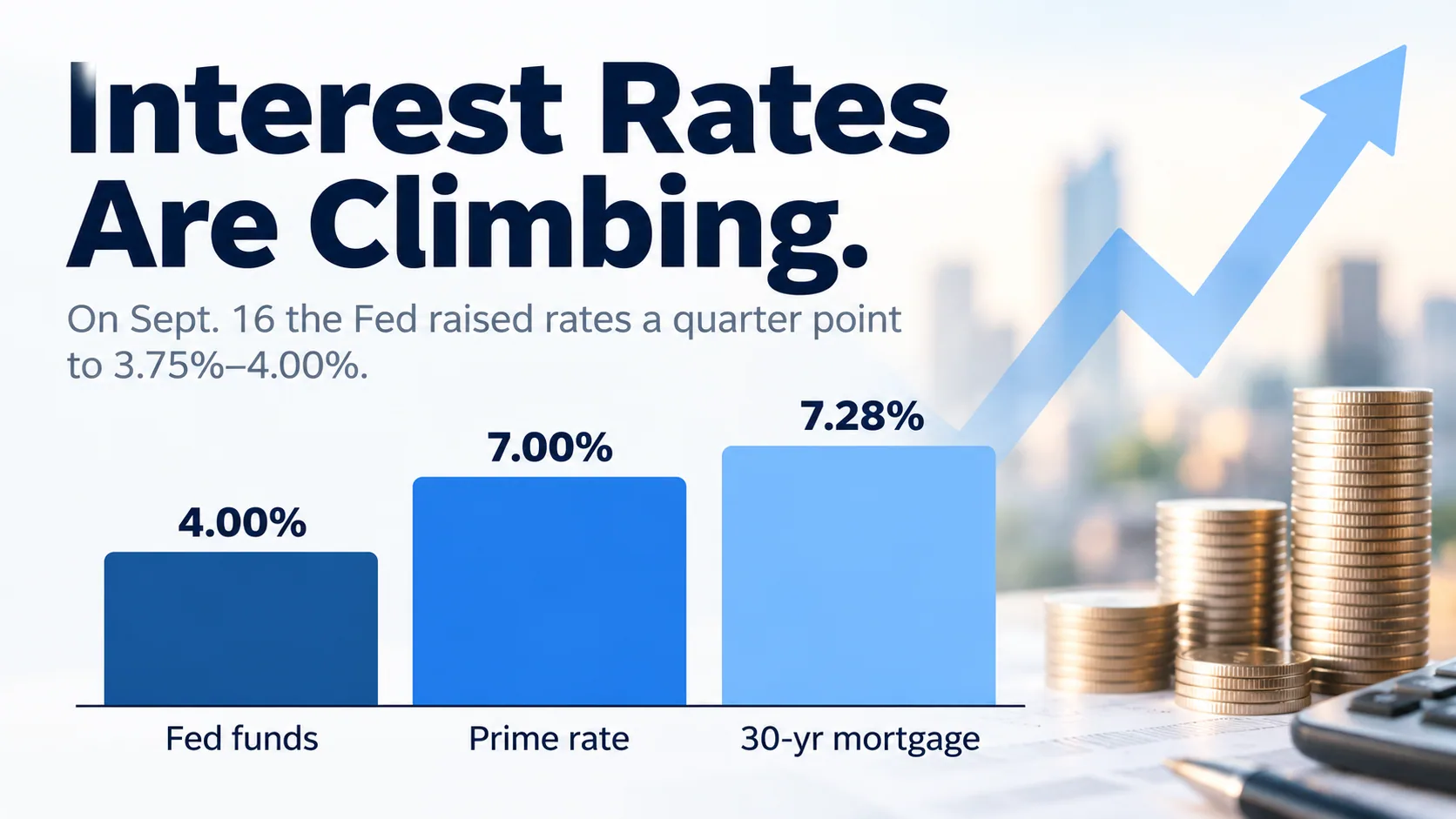
Interest rates influence the cost of borrowing and the potential earnings from interest-bearing savings. Central banks may raise policy interest rates to help control inflation by reducing borrowing and spending.
The effects of rising interest rates commonly include:
- Higher borrowing costs: New personal loans, mortgages, and business loans may carry higher interest rates.
- Increased credit card expenses: Variable-rate credit cards may become expensive when benchmark rates increase.
- Potentially higher savings yields: Some banks may increase interest rates on savings accounts and certificates of deposit.
- Changes in housing demand: Higher mortgage payments may reduce the number of buyers who can afford certain properties.
- Investment price fluctuations: Bonds, stocks, and other assets may respond differently to interest rate changes.
- Reduced consumer spending: Households facing higher debt payments may adjust their budgets.
These outcomes depend on the size and timing of rate increases, economic conditions, and the financial products involved.
How Interest Rates Affect the Economy
Understanding how interest rates affect the economy can explain why central banks adjust monetary policy.
When inflation remains elevated, a central bank may raise its policy rate to make borrowing expensive. Higher borrowing costs can encourage households and businesses to reduce spending or postpone purchases.
For example, a business planning to borrow $100,000 for equipment may reconsider the purchase if its financing rate increases significantly.
Similarly, households may delay purchasing vehicles, renovating homes, or taking out personal loans when financing becomes expensive.
However, the relationship between interest rates and economic activity is not immediate. It can take time for changes in monetary policy to influence lending, spending, employment, and inflation.
Rising Interest Rates and Inflation
The relationship between rising interest rates and inflation is an important part of monetary policy.
Higher interest rates may reduce demand for goods and services by encouraging saving and discouraging borrowing. When demand slows, businesses may have less flexibility to increase prices.
However, rate increases cannot directly resolve every cause of inflation. Supply shortages, energy prices, and international economic developments can continue affecting consumer prices.
Therefore, interest rate increases may help reduce inflation over time, although the outcome is uncertain.
Impact of Interest Rates on Loans and Credit Cards
The impact of interest rates on loans depends heavily on the financing arrangement.
Fixed-rate loans generally maintain the same contractual interest rate throughout their fixed-rate period. Variable-rate loans may change when the underlying benchmark rate adjusts.
Personal Loan Example
Suppose you borrow $20,000 and repay it over five years with equal monthly payments.
| Annual interest rate | Approximate monthly payment | Total interest |
|---|---|---|
| 6% | $387 | $3,199 |
| 9% | $415 | $4,910 |
| 12% | $445 | $6,693 |
Illustrative calculations assume a fully amortizing loan with 60 monthly payments, no additional fees, and an unchanged interest rate.
At 6%, the monthly payment would be approximately $387. At 12%, it would increase to approximately $445.
That difference represents about $58 in additional monthly expenses and approximately $3,494 in additional interest over five years.
These figures demonstrate why comparing annual percentage rates, repayment terms, and fees can be helpful before accepting a loan.
Credit Card Interest Expenses
Credit cards commonly have variable interest rates, meaning the annual percentage rate may increase when the relevant benchmark changes.
For example, suppose you carry a $5,000 credit card balance at a 20% APR.
A simplified calculation suggests approximately $83 in interest for one month. If the APR increases to 25%, that estimate rises to approximately $104.
Actual interest charges depend on daily balances, payment timing, compounding methods, and the card agreement.
If you regularly carry a balance, reviewing lower-rate borrowing alternatives or a repayment plan may help you manage interest expenses.
Mortgage Rates and Housing Affordability
The relationship between mortgage rates and housing affordability becomes especially noticeable when borrowing costs increase.
Higher mortgage rates can increase monthly payments for new borrowers. This may reduce purchasing power even when home prices remain unchanged.
Example: A $300,000 Mortgage
Suppose you finance $300,000 through a 30-year fixed-rate mortgage.
| Mortgage rate | Monthly principal and interest | Total interest over 30 years |
|---|---|---|
| 4% | $1,432 | $215,609 |
| 6% | $1,799 | $347,515 |
| 7% | $1,996 | $418,527 |
These are illustrative principal-and-interest calculations. They exclude property taxes, homeowners insurance, mortgage insurance, closing costs, and other expenses.
A borrower with a 7% mortgage would pay approximately $564 extra per month compared with a borrower financing the same amount at 4%.
Over the full repayment period, the difference in interest expenses could be substantial.
However, home prices, down payments, loan terms, and local housing conditions can change the actual cost of purchasing a property.
Should You Buy a Home When Interest Rates Are High?
Buying a home during a period of higher interest rates may still make financial sense if the property fits your budget and long-term plans.
Before applying for a mortgage, review:
- Your expected monthly mortgage payment
- Property taxes and homeowners insurance
- Down payment requirements
- Closing costs and lender fees
- Emergency savings after purchasing
- The possibility of refinancing later, without assuming lower rates will become available
Comparing loan estimates from several lenders may help you identify financing terms that fit your circumstances.
Interest Rates and Savings Accounts
The relationship between interest rates and savings accounts can be favorable for people keeping money in interest-bearing deposits.
When market interest rates increase, banks may raise the annual percentage yields on certain savings products.
However, financial institutions determine their own deposit rates, and not every account responds equally.
Example: Savings Interest Earnings
Suppose you deposit $10,000 into a savings account and leave it untouched for one year.
| Annual percentage yield | Earnings after one year | Ending balance |
|---|---|---|
| 1% APY | $100 | $10,100 |
| 3% APY | $300 | $10,300 |
| 4% APY | $400 | $10,400 |
Examples assume the stated APY remains unchanged throughout the year, with no withdrawals, deposits, fees, or taxes.
At 4% APY, a $10,000 balance would generate approximately $400 in annual interest.
This demonstrates why reviewing savings yields may be worthwhile when interest rates increase.
What Should You Look for in a Savings Account?
Before opening an account, compare its APY, minimum balance requirements, maintenance fees, withdrawal conditions, and applicable deposit insurance.
High-yield savings accounts may provide competitive interest earnings, although their rates are generally variable.
Certificates of deposit may provide a fixed rate for a specified term, making them useful for funds you do not expect to need immediately. Early withdrawal penalties may apply.
The appropriate choice depends on your savings goals, liquidity needs, and tolerance for changing rates.
How Rising Interest Rates Affect Investments
Understanding how rising interest rates affect investments can help you evaluate potential risks before changing your portfolio.
Different investment categories may react differently to rate increases.
Bonds
Bond prices generally move in the opposite direction of market yields.
When interest rates rise, existing fixed-rate bonds with lower coupon payments may become less attractive than newly issued bonds paying higher rates.
As a result, the market value of existing bonds may decline.
Longer-duration bonds generally experience greater price sensitivity to interest rate changes than shorter-duration bonds.
However, investors holding individual bonds to maturity may still receive the scheduled principal repayment, assuming the issuer meets its obligations.
Stocks
Higher interest rates may affect companies by increasing financing expenses and reducing consumer demand.
Businesses that depend heavily on borrowing may face pressure on profits when financing costs increase.
However, stock market performance depends on many factors, including corporate earnings, investor expectations, economic growth, and industry conditions.
Higher interest rates do not automatically mean stock prices will decline.
Real Estate Investments
Real estate investors may face increased financing expenses when purchasing properties or refinancing debt.
Higher borrowing costs can influence property valuations, rental investment calculations, and expected returns.
Before purchasing investment property, evaluate mortgage expenses, maintenance costs, vacancies, taxes, and potential changes in rental income.
How Rising Interest Rates Affect Everyday Spending
Interest rate increases can influence household budgets even when you do not plan to apply for a new loan.
For example, higher financing costs may affect businesses that rely on credit to purchase inventory, expand operations, or manage expenses.
Some businesses may respond by adjusting prices, postponing expansion, or reducing expenses.
Meanwhile, households with variable-rate debt may have less disposable income after making monthly payments.
The effects vary according to existing debt obligations, income stability, savings, and spending habits.
Example of a Monthly Household Budget
Suppose your household previously spent:
- $1,500 on housing payments
- $400 on vehicle financing
- $200 on credit card payments
- $900 on other essential expenses
Your total monthly expenses would be $3,000.
If variable borrowing costs increased your housing and credit payments by a combined $150, your revised expenses would reach $3,150.
That additional expense could affect how much you save each month.
This is a hypothetical illustration rather than a prediction of how your expenses will change.
How to Prepare Financially for Rising Interest Rates
Although you cannot control central bank decisions, you can review your finances and identify areas that may be sensitive to interest rate changes.
1. Review Your Existing Debt
Identify which loans have fixed interest rates and which have variable rates.
Variable-rate obligations may deserve particular attention because their payments or financing costs can change.
2. Compare Borrowing Options
Before taking out a new loan, compare APRs, repayment periods, fees, and total borrowing costs.
A lower monthly payment may seem attractive, although a longer repayment term can increase total interest expenses.
3. Evaluate High-Interest Debt Repayment
Paying down expensive credit card debt may reduce future interest charges.
For example, reducing a balance subject to a 24% APR could lower interest expenses, depending on how payments and interest are calculated.
4. Review Savings Account Yields
Compare available savings products to determine if your current account remains competitive.
Pay attention to fees, minimum deposits, withdrawal restrictions, and deposit protection.
5. Maintain Emergency Savings
An emergency fund may help cover unexpected expenses without relying immediately on expensive credit.
The appropriate amount depends on household expenses, income stability, and existing financial obligations.
6. Evaluate Your Investment Allocation
Review your portfolio according to your investment timeline and risk tolerance.
Avoid making decisions based solely on short-term interest rate announcements.
Frequently Asked Questions About Rising Interest Rates
Are rising interest rates good or bad?
Rising interest rates can have positive and negative financial consequences. Savers may benefit from higher deposit yields, while borrowers may face increased financing costs. The overall effect depends on your financial circumstances.
Do higher interest rates automatically increase mortgage payments?
No. Existing fixed-rate mortgages generally maintain their contractual interest rates during the fixed-rate period. Adjustable-rate mortgages may experience payment changes according to their loan agreements.
Can rising interest rates reduce inflation?
Higher interest rates may help reduce inflation by slowing borrowing and consumer spending. However, inflation also depends on supply conditions, energy costs, employment, and other economic factors.
Should you pay off debt when interest rates rise?
Paying down high-interest variable-rate debt may help reduce borrowing expenses. However, you should also review emergency savings, potential prepayment penalties, and other financial priorities.
Do savings accounts automatically earn higher interest?
No. Banks determine their deposit rates, and some institutions may respond slowly or make limited adjustments. Comparing APYs can help you evaluate available accounts.
What happens when interest rates start falling?
New borrowing rates may decline, although changes are not guaranteed or immediate. Variable-rate loans may become less expensive, while savings account yields may decrease. Existing fixed-rate loan payments generally remain unchanged.
Final Thoughts: Making Financial Decisions During Rising Interest Rates
The effects of rising interest rates depend on your borrowing arrangements, savings products, investments, and household budget.
Higher rates may increase financing costs for mortgages, personal loans, and credit cards. At the same time, certain savings products may generate higher interest earnings.
Before making financial decisions, compare borrowing terms, calculate potential repayment expenses, and review how changing interest rates could affect your long-term goals.
Taking time to evaluate your options may help you manage expenses and make financial decisions that align with your circumstances.