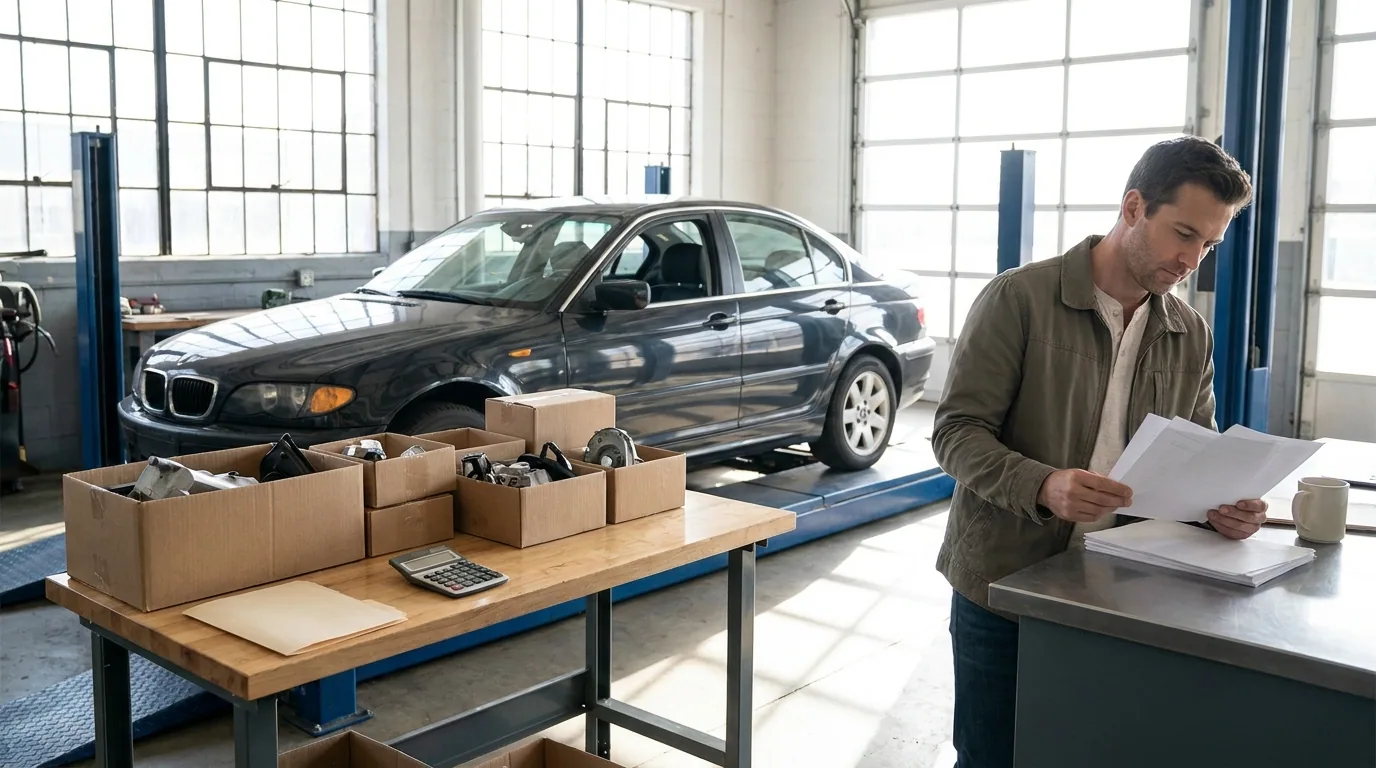
A collision repair bill is mostly parts and labor; replacing a written-off car means buying another vehicle. Tariffs on imported goods, including steel and aluminum, push up the cost of both, and those are the costs insurers pay out of premium revenue.
Nothing on a declarations page mentions trade policy, but that's the route from a tariff announcement to a renewal notice.
Tariffs on Steel and Aluminum Make Repairs More Expensive
Most of what a collision repair shop bolts onto a car is metal, and tariffs on steel and aluminum are expected to push up what that metal costs. When the parts get more expensive, the estimate for the same damage comes out higher.
For an insurer, that shows up as a larger average payout per claim. A carrier that settles the same number of fender benders next year as this year can still pay out more, simply because each repair estimate is bigger.
Premiums are the tool insurers use to cover that gap, so higher parts costs tend to work their way into rates.
Imported Cars Are Costlier to Replace After a Total Loss
The other route runs through the vehicle itself. Tariffs make imported cars more expensive to buy, and a car that costs more to buy costs more to replace when it's written off after a crash. Comprehensive and collision claims on those vehicles get more expensive for the same reason repair claims do.
Total-loss settlements work a little differently, though, and the distinction matters. A settlement is normally based on what the vehicle was worth at the time of the loss, not on what a comparable new model would cost today.
Rising sticker prices on imports affect what insurers pay across their whole book of claims, while an individual payout still turns on the market value of that specific car, its mileage, and its condition.
Higher Costs Reach Policyholders Slowly, at Renewal
Insurers don't reprice a policy the day a cost estimate changes. What's more likely is a slow adjustment as claims data comes in and carriers file new rates, which reach individual drivers at renewal rather than mid-term.
The direction is the part worth noting. Rates get built to cover expected claim costs, so when those costs stay high, the prices filed afterward tend to match them. Premiums are where that arithmetic ends up. That leaves drivers with the parts of the bill they can still influence.
Quotes for the Same Coverage Land Far Apart Across Carriers
Every insurer runs its own rating formula, weighting the same driver, car, and address differently. That's why quotes for identical coverage can land far apart, and it's why shopping the market tends to do more than any single discount. Online quoting makes it possible to collect several prices in one sitting.
Prices only mean something side by side when the coverage matches, which is the one thing a quote screen won't flag. Different liability limits, a different deductible, or a dropped optional coverage can make one quote look cheaper when it's really just smaller.
A Clean Driving Record Sets the Baseline
Drivers without at-fault accidents or moving violations generally see the lowest rates available to them. Speeding tickets and at-fault claims work the other way.
This is the least glamorous item on any savings list and also the one that underpins most of the others, since discounts and telematics rewards are usually layered on top of a record-based price.
Discount Lists Are Long and Not Always Applied Automatically
Carriers keep long discount lists, and not all of them attach to a policy on their own. Some turn on who the driver is, some on equipment already installed in the car, and some on finishing a training course the carrier recognizes, which carries the side benefit of a refresher on skills that fade with routine.
The full list is something a carrier will go through on request. Eligibility also shifts as circumstances change, so it isn't a one-time check.
Bundling Home and Auto With One Insurer
Buying more than one policy from the same company, most often auto plus homeowners, frequently earns a multi-policy discount.
Whether it beats two separately shopped policies depends on the carrier, which is why the bundled price is worth comparing against standalone quotes rather than assumed to be lower.
Raising the Deductible: Lower Premium, Bigger Bill Per Claim
On a covered claim, the first slice of the repair bill belongs to the policyholder, and the deductible is what sets how big that slice is. A larger one generally buys a lower premium.
The trade is straightforward. Say a driver raises the deductible and banks the monthly savings, then backs into a pole eighteen months later.
The repair bill now starts with their own money, up to that higher deductible amount, before coverage applies. The savings are real and so is the exposure, which is why the choice tends to hinge on what cash is available on short notice.
Dropping Comprehensive or Collision Leaves Your Own Car Uncovered
On an older, low-value vehicle, some drivers drop comprehensive or collision coverage. That cuts the premium. It also strips out the coverage that pays for damage to the insured vehicle itself, leaving those repairs to the owner. Liability, a separate piece of the policy, keeps running.
Two things complicate the decision. Lenders and lessors typically require these coverages on a financed vehicle, so the option often isn't available until the loan is paid off. And the value of the coverage shrinks as the car's value does, which is why the question comes up on old cars and rarely on new ones.
Pay-per-Mile Policies Bill by Distance Driven
Drivers who rarely use their car may pay less with a pay-per-mile insurer, where the bill scales with distance driven: fewer miles, less exposure, lower cost. For a commuter putting in daily highway hours, the math generally runs the other way.
Telematics Trades Some Privacy for a Possible Discount
A telematics program watches how a car gets driven and reports back to the insurer, and many carriers pay for that access with a discount. Careful driving is what earns the lower rate, so how much the enrollment is worth depends on what the program records.
On the other side of the ledger sits a record of when, where, and how a driver drives, held by the company.
Paying the Full Premium Upfront Can Carry a Discount
Installment billing is convenient and often costs a little more. Insurers commonly offer a discount to policyholders who pay the entire term's premium in one payment, which makes this a savings option for households with the cash on hand rather than a universal one.
What Each Cost-Cutting Move Trades Away
| Move | What you give up |
|---|---|
| Higher deductible | More out of pocket per claim |
| Dropping comprehensive or collision | Coverage for your own vehicle |
| Telematics enrollment | Driving data and some privacy |
| Paying the term upfront | Flexibility of monthly cash flow |
| Bundling policies | Freedom to shop each policy separately |
Costs the Insurer Absorbs, Choices the Driver Makes
The tariff pressure lands on the insurer's side of the ledger: parts prices, repair estimates, the cost of replacement vehicles. No policyholder negotiates those.
What sits on the driver's side is narrower and more concrete, and it comes down to coverage limits, the deductible, how many miles the car actually covers, the discount list nobody read out loud, and how recently more than one carrier priced the same coverage.
How much of that is genuinely in play depends on the household. Drivers who barely use their cars and drivers with spotless records have room to work with; a household with a financed vehicle and limited savings has less, since the deductible and the optional coverages are largely fixed for them.
For that household, what's left to work with is the full discount list and a set of quotes gathered at matching coverage.