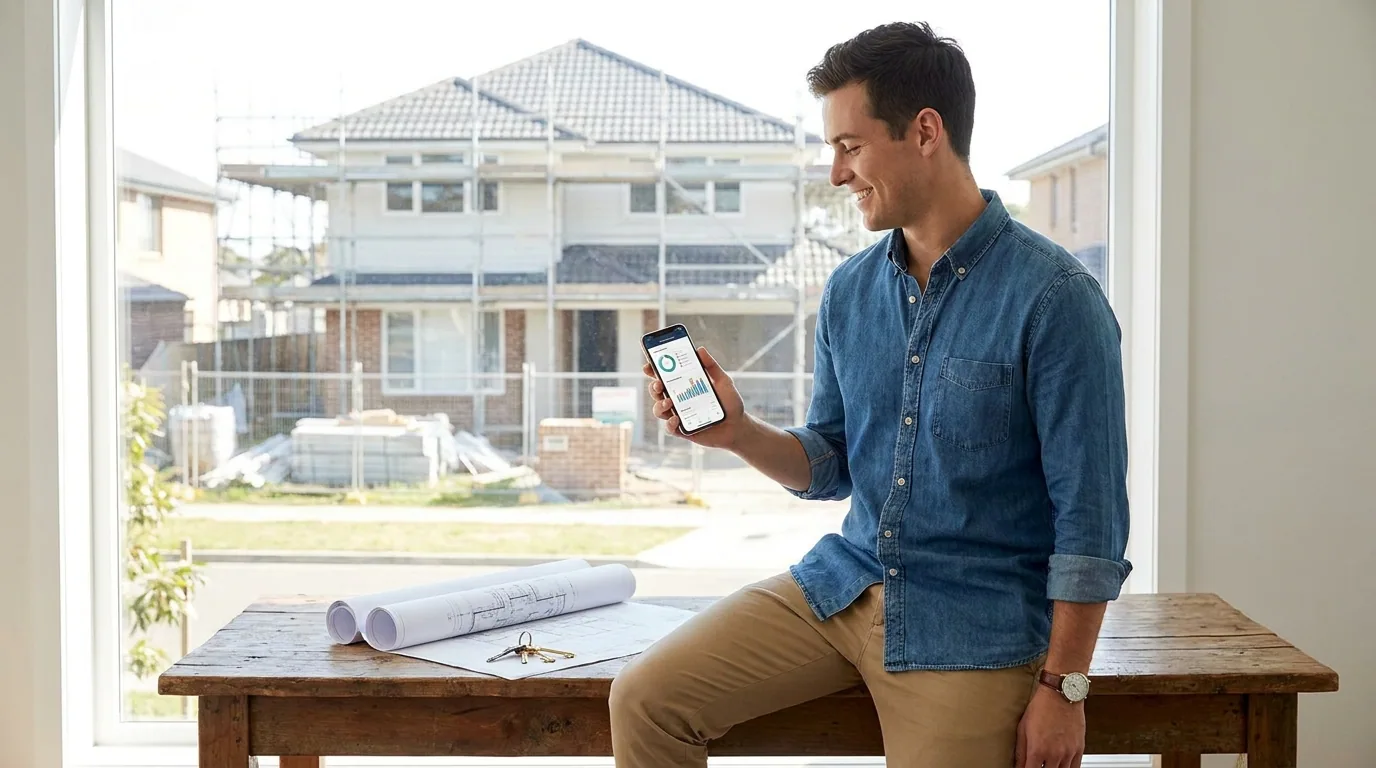
Groundfloor makes loans to house flippers, then sells shares of those loans to individual investors. The minimum is $100, investors pay no fees, and the company says the average investor is repaid within six to nine months. The collateral behind the loan is a property that isn't finished yet.
How a Groundfloor Loan Reaches Investors
Brian Dally and Nick Bhargava founded Groundfloor in 2013, and the company is based in Atlanta, Georgia. It runs a crowdsourced real estate lending platform: borrowers, mostly fix-and-flip investors, list projects, and individual investors put money behind the ones they pick.
It isn't quite peer-to-peer lending. Groundfloor makes the loan to the borrower itself. It then converts that loan into a security registered with the U.S. Securities and Exchange Commission, called a Limited Recourse Obligation (LRO). What you buy is shares of that LRO. Your return comes from the interest the borrower pays, and you know the interest rate before you commit.
Borrowers either pay interest monthly or defer it until the whole loan is repaid, which shapes when money lands in your account. A deferred loan means no cash flow at all until the project sells or refinances.
One structural point sits in a debt investor's favor: a lender's claim outranks an owner's. Money coming out of a deal has to clear the loan first, and only what's left counts as the borrower's gain. That doesn't remove risk, but it changes where you stand in line.
Minimums, Fees, and Account Types at a Glance
| Feature | Detail |
|---|---|
| Minimum investment | $100 |
| Investor management fees | None |
| Account types | Individual (taxable), self-directed IRA |
| Investment style | Debt investing |
| Distributions | Monthly or deferred until repayment |
| Typical repayment | Six to nine months on average |
The $100 minimum is a change from the platform's earlier $10 floor. It's still low enough that someone can spread a few hundred dollars across several loans rather than betting it all on one flip.
Investors Pay No Fees, but Borrowers Pay Several
Groundfloor doesn't charge investors anything. It earns money on the spread, the gap between the rate it charges borrowers and the rate it pays the people funding those loans.
Borrowers carry the fees instead:
- A $495 application fee
- $1,250 in closing costs once the loan funds
- An underwriting fee between 2.75% and 4% of the loan amount
A platform paid from the difference between two rates has an incentive to keep loan volume flowing. That isn't a knock on Groundfloor specifically; it's how most lending marketplaces work. It is a reason to read each deal on its own terms rather than assuming the platform's screening matches your own risk tolerance.
Grades A Through G, and the Fields Behind Each Deal
Every opportunity gets a letter grade from A through G reflecting its overall risk. Grade A loans carry lower risk and lower interest rates. Grade G loans pay more but experience higher loan losses. That trade-off is the whole point of the scale, and it's the first filter most investors reach for.
Beyond the grade, you can sort and analyze deals on a fairly deep set of criteria:
- The interest rate the loan pays you
- Loan to ARV: how large the loan is next to what the property is expected to be worth once the renovation is done
- A loan-to-ARV score on a 1 to 10 scale, which slides down a point with each 10% of that projected value the borrower has taken on as debt
- Cushion, also called equity: what sits between the projected after-repair value and the loan amount
- Loan position, which sets who gets paid first out of a sale. Groundfloor's loans usually sit in first position.
- Skin in the game: how much of the borrower's own money is tied up in the project
- The valuation report behind the ARV figure. Groundfloor accepts four kinds, and they don't carry equal weight. A certified independent appraisal sits at the top of that ranking; comps the borrower supplies themselves sit at the bottom.
- Location, scored partly on whether the property sits in a judicial or nonjudicial foreclosure state, which affects how easily Groundfloor can foreclose if payments stop
That last item catches people off guard. Two loans can look identical on rate and cushion, but if one is in a state where foreclosure runs through the courts, recovering money after a default takes a different path than in a nonjudicial state.
The Flywheel Portfolio Bundles 200 to 400 Loans
For investors who'd rather not read individual deals, Groundfloor offers Flywheel, an actively managed real estate lending portfolio made up of between 200 and 400 different loans. Terms run 36 months or less, with most maturing within 24 months.
That's a longer horizon than the six-to-nine-month average on individual loans, in exchange for exposure spread across hundreds of borrowers instead of a handful. A single default in a 300-loan portfolio is a much smaller event than a single default when you've funded three loans.
Which Properties Qualify as Collateral
The collateral behind these loans is generally non-owner-occupied residential real estate:
- Single-family residences
- Multi-family properties with 1–4 units
- Condos
- Townhomes
- Planned unit developments (PUDs)
Groundfloor doesn't lend on mobile homes, properties sitting on 3.5 or more acres, raw land lots, or commercial real estate. Anyone looking for office, retail, or industrial exposure won't find it here.
Who Can Open an Account, Including Investors Abroad
You don't need to be an accredited investor. The platform is open to U.S. investors over 18 across 49 states; Nebraska residents are excluded because of state-specific legislation. Signup asks accreditation questions anyway, but answering "no" doesn't shut the door.
International investors can also participate. After opening an account, they need to contact Groundfloor customer service to enable it, and non-U.S. investors must transfer at least $5,000 to open an account.
There are two account options: a taxable individual account, or a self-directed IRA. Because this counts as an alternative investment, retirement money has to go through a self-directed IRA: traditional, Roth, SEP, Simple, or rollover.
Signing Up Takes Four Steps
- Register on the Groundfloor site with your name, email address, and a password.
- Answer the accredited investor questions. Approval is immediate.
- Link a bank account and provide your Social Security number.
- Transfer money in, then start choosing loans.
Returns Have Averaged Around 10%, With No Guarantee They Repeat
Groundfloor reports that the average investor has earned around 10% to date, and that it has paid out over $80 million in interest to investors since 2013. Those are the platform's own figures, and they describe what has happened, not what will.
Your own result depends on which loans you pick, how long you stay invested, and how much risk you take on. A portfolio weighted toward Grade G loans and one weighted toward Grade A loans are two different investments on the same platform.
The downside case is straightforward. If a borrower doesn't repay, you can lose the money you put in. There are no guarantees of return, and none of the money here carries deposit insurance.
Money Stays Committed Until the Loan Repays
No secondary market is described for these positions. Once you've funded a loan, your money stays there until the loan is repaid, or until whatever happens after a default resolves. Six to nine months isn't long by real estate standards, but it's an eternity if the cash was earmarked for something else.
The deferred-interest option makes this sharper. Picture someone who puts $500 across five loans, all of them structured with deferred interest. For months, the account shows accrued interest and no deposits. Nothing has gone wrong; that's how the loan was written. But anyone expecting a monthly check will be surprised.
A finished, rented house has a market value someone can look up. A half-gutted flip is worth less than either its purchase price or its projected ARV, and ARV is a projection rather than a price. That's what the cushion, skin-in-the-game, and valuation-quality fields are measuring.
Fundrise and DiversyFund Sit on the Equity Side
Groundfloor is a debt play: you're the lender, and the interest rate caps what you can make. Platforms that sell ownership stakes work the other way, since what an owner collects depends on rents and on what the property fetches later.
- Fundrise invests in both commercial and residential projects, with multiple investment levels and a $10 starting point. More functionality opens up as an account balance grows.
- DiversyFund runs a REIT focused on multi-family properties, with a $500 minimum. Every investor holds a proportional interest in all the properties in the REIT, regardless of account size.
The distinction matters more than the minimums. Equity investors are betting on property values and rents rising, usually over years. Debt investors are betting on getting paid back, usually over months.
Who Groundfloor Fits and Who It Doesn't
Real estate exposure without buying, renovating, or managing anything, at a stated interest rate over a horizon measured in months: that's what's on offer. The $100 entry, the absence of investor fees, and the lack of an accreditation requirement make it easy to try at small scale.
The friction shows up elsewhere. Money committed to a loan isn't available on short notice. Whether income arrives monthly depends on how the borrower's loan was written. And some investors won't want to hold a claim secured by a house that's still under construction, whatever the letter grade says. Those grades sort risk rather than removing it, and choosing among them is left to the investor.