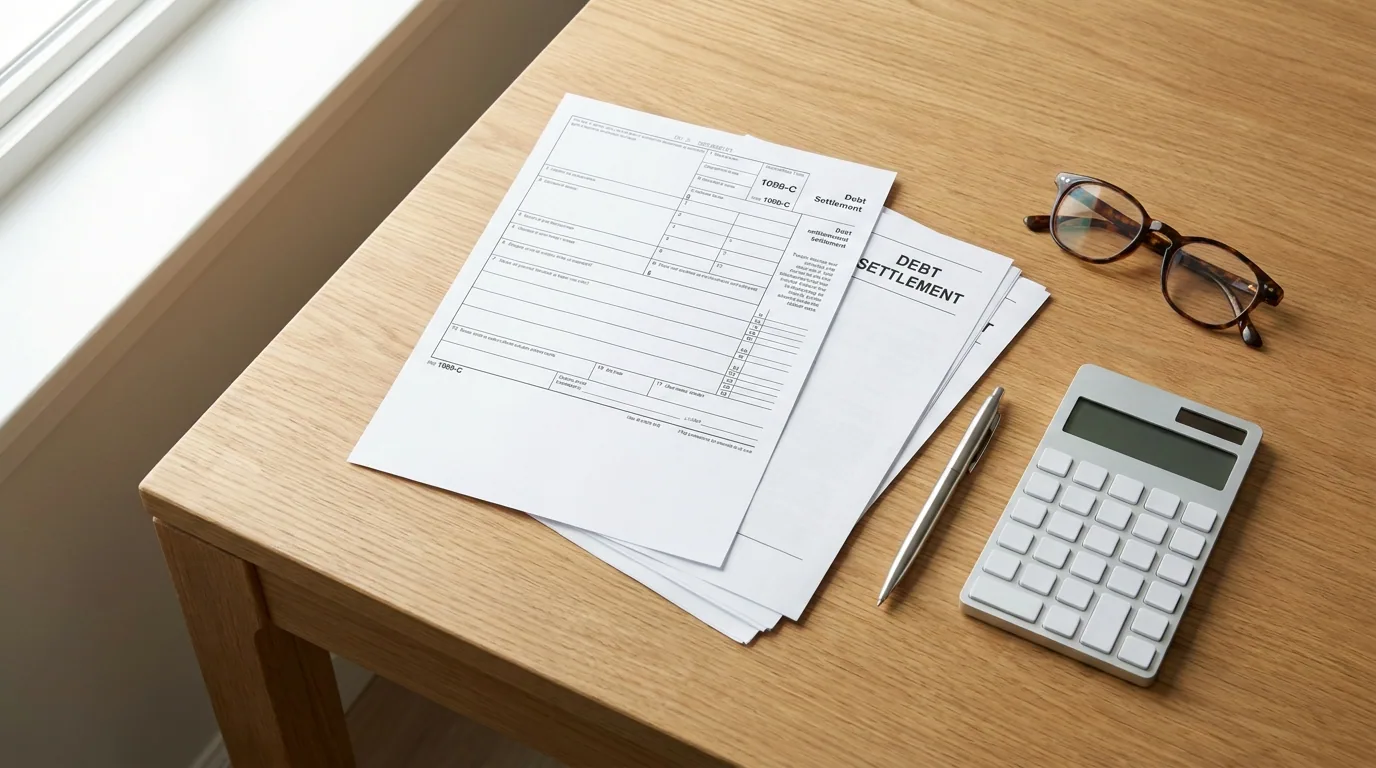
Settling a debt for less than the balance ends the account. It also creates a tax form. The creditor sends a 1099-C the following January listing the amount it wrote off, and that figure goes on the return as income. For most people the first part is the whole point of settling; the second part is the surprise.
Canceled Debt Counts as Income to the IRS
A settlement is an agreement in which the creditor takes a partial payment and writes off the remainder. From the IRS's point of view, the portion you borrowed and never repaid is income, and income is taxable.
The reasoning turns on the benefit you already received. Borrowed money that has been spent stays spent. When the obligation to pay it back disappears, what's left in the borrower's hands is value nobody paid for, which is why forgiveness is treated as money received rather than as a clean slate.
The 1099-C Goes on Schedule 1 and Is Taxed at Your Regular Rate
A settlement closed in a given year should produce a 1099-C from the lender, breaking down the canceled amount. That form gets filed along with your tax return.
Where personal debt is what got canceled, Schedule 1 has a line for the income, 8c, and the schedule travels with the 1040.
The form is also the IRS's copy. A lender that issues a 1099-C reports it, so leaving the amount off a return is not the same as it going unnoticed.
There is no separate rate or special category for canceled debt. Once it's on the return, it's lumped in with your other income and paid as part of your regular tax bill.
One practical consequence: nothing was withheld from it. Paycheck withholding is set up around wages, not around a forgiven balance that appeared mid-year, so canceled debt tends to show up as an amount owed at filing time rather than a smaller refund.
Taxable by Default, With a Short List of Exclusions
Forgiven debt is taxable income unless a specific rule says otherwise. A credit card balance knocked down in a settlement counts. So does a student loan balance wiped out at the end of an income-driven repayment plan. A handful of situations are carved out.
| Situation | General treatment |
|---|---|
| Settled credit card debt | Likely taxable income |
| Student loan forgiveness after an income-driven repayment plan | Likely taxable income |
| Forgiveness through Public Service Loan Forgiveness (PSLF) | Excluded |
| Forgiveness through a health services program for underserved areas | Excluded |
| Debt canceled in a Title 11 bankruptcy case | Excluded |
| Qualified farm indebtedness | Excluded |
| Canceled debt that is part of an inheritance, bequest, or gift | Excluded |
State tax treatment is a separate question from the federal one and depends on where you live, so an amount that's handled one way on a 1040 isn't automatically handled the same way on a state return.
Repossessed Property Is Treated as a Sale to the Creditor
When property is repossessed, the transaction is usually treated as though you sold it to the creditor. Whether the loan paperwork left the borrower personally on the hook for the property changes how much of the forgiven debt counts as income.
That calculation is narrower and more technical than a simple credit card settlement. It's one of the cases where the type of debt has to be pinned down before the taxable amount can be figured out at all.
Settlement Programs Can Produce a 1099-C Several Years Running
Debts inside a settlement program rarely resolve on the same schedule. One creditor may agree to terms in one year while another holds out and settles later, which means a 1099-C can arrive for several years in a row.
Picture someone working through three accounts: two creditors settle in the spring, the third doesn't come to terms until the following year. That's forgiven income reported across two separate tax years, each with its own filing and its own bill.
The Insolvency Test and the Records Behind It
Beyond the listed exclusions, there's an insolvency test. It compares total liabilities against the fair market value of everything owned, measured immediately before the cancellation.
If the liabilities are the larger number, taxes on the forgiven amount may be avoidable on that basis. It's a claim you have to be able to support with figures, not a status the IRS assigns on its own.
If the plan is to argue that a forgiven amount shouldn't be taxed, documentation carries the argument. That applies to proving insolvency as of the settlement date and to showing that a debt belongs in a category that isn't taxed.
Some business and farm debt, for example, doesn't produce a tax bill, but only if it's properly documented as such.
Useful items to have on hand include the settlement agreement, the 1099-C itself, and a picture of what you owed and owned at the time.
The Tax Bill Arrives Long After the Settlement Is Done
The gap between the two events is easy to underestimate. A debt settled early in the year generates a form the following January and a payment due at filing time, by which point the cash used to fund the settlement is long gone.
Setting money aside in the stretch between the settlement and tax day is what closes that gap. Some people use a savings account for it; others treat it the way they'd treat any known upcoming bill.
Debt settlement companies negotiate balances, not tax liability, so the amount owed on the forgiven portion is generally handled separately from whatever the program covers.
IRS Payment Plans Carry Extra Fees
When the bill can't be covered by April 15, the IRS has payment plan options, subject to eligibility.
An installment agreement spreads the balance across monthly payments, the size of the balance affects which arrangements are open to you, and setting one up carries fees on top of the tax itself. A balance left unpaid stays owed to the IRS either way.
Where the Taxable Amount Is a Judgment Call
A credit card settlement is usually straightforward. Repossessed property, mixed business and personal debt, and insolvency calculations are not, and the answer changes the taxable figure.
A tax professional can confirm which forgiven amounts actually belong on the return, which fall under an exclusion, and how to calculate the taxable portion when the property or note history is complicated.
What Stays Open After the Account Closes
Settling a debt closes the account but not the file. A 1099-C may be on its way for that tax year, or an exclusion or the insolvency test may keep the forgiven amount off the return entirely, and that's what decides whether there's a bill to plan for.
In a program that resolves accounts over two or three years, the question comes up again each time a creditor agrees to terms.