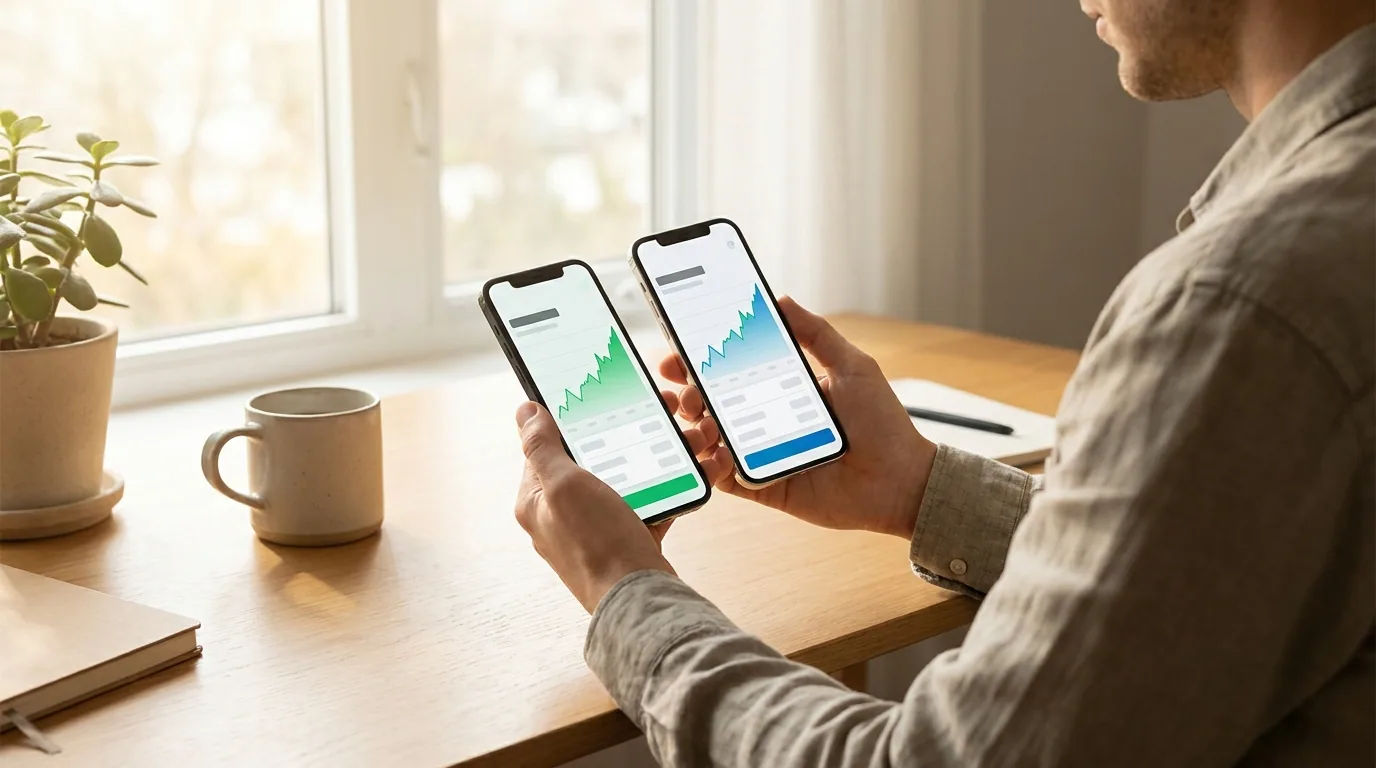
Investment platforms can give you very different levels of control over your money. Some let you select individual stocks and funds yourself while providing optional automation. Others operate primarily as robo-advisors, building and maintaining a diversified portfolio based on your goals and risk tolerance.
Understanding these differences can help you decide whether you prefer hands-on investing, automated portfolio management, or something between the two.
Compare the Fee Structures First
Investment-platform fees generally fall into two common categories: fixed subscription charges and percentage-based advisory fees.
A fixed monthly fee stays the same regardless of how much money you invest. This makes the fee proportionally more expensive for smaller portfolios.
For example, a $12 monthly subscription costs $144 annually. On a $1,000 portfolio, that's equivalent to 14.4% of the balance before considering investment performance or other expenses.
A percentage-based advisory fee works differently. The dollar amount increases as your portfolio grows while remaining proportional to the assets being managed.
Remember that management or subscription charges may not represent your complete cost. ETFs and other funds can carry their own expense ratios.
Decide How Much Investment Control You Want
The biggest distinction between investing platforms may be how securities are selected.
A self-directed platform allows you to choose individual stocks and ETFs. This provides greater control but also places more responsibility on you to research investments, determine allocations, and manage diversification.
Automated platforms typically ask questions about your:
- Financial goals
- Investment timeline
- Risk tolerance
- Financial circumstances
The service then recommends a portfolio, commonly consisting of ETFs providing exposure to domestic and international stocks and bonds.
Neither structure eliminates investment risk.
Fractional Shares Can Make Investing More Accessible
Some self-directed platforms offer fractional shares, allowing you to invest a specific dollar amount rather than purchasing an entire share.
This can be useful when a stock or ETF has a relatively high share price. Instead of letting the price of one full share determine your investment, you can allocate money according to your budget.
Fractional-share availability varies by brokerage and security, so check the platform's rules before assuming every investment is eligible.
Understand Automatic Portfolio Management
Automated investing services can handle tasks that self-directed investors would otherwise need to perform themselves.
One important example is portfolio rebalancing.
If market movements cause your investments to drift away from their target percentages, an automated system can buy and sell assets to restore the intended allocation.
Some services also automatically reinvest dividends, keeping distributions invested rather than allowing them to accumulate as cash.
Automation can make portfolio maintenance easier, but it doesn't guarantee better performance or prevent losses.
Look at Tax-Loss Harvesting
Tax-loss harvesting is available through some automated investment services.
The strategy generally involves selling an eligible investment at a loss and potentially using that realized loss to offset certain taxable gains, subject to applicable tax rules. A similar investment may then be purchased to maintain market exposure.
Not every platform offers this feature.
Tax-loss harvesting is primarily relevant to taxable investment accounts rather than tax-advantaged retirement accounts. It also doesn't guarantee tax savings, since the benefit depends on your individual tax circumstances.
Compare Available Account Types
The account you need can quickly narrow your options.
Common choices include individual taxable brokerage accounts and Traditional and Roth IRAs. Some platforms go further by supporting joint taxable accounts, SEP IRAs, inherited retirement accounts, trusts, rollovers, or custodial accounts for minors.
More account types aren't automatically better. The important question is whether the service supports the particular account structure you need.
If you're self-employed, investing jointly, managing assets for a child, or handling inherited retirement assets, this comparison can become especially important.
Consider Cash-Management Features Separately
Some investment platforms also provide cash-management or banking-related features.
Depending on the service, these may include checking-style accounts, debit cards, interest-bearing cash accounts, automated savings transfers, or round-up features connected to everyday purchases.
These extras can make managing finances more convenient, but they shouldn't distract from the investment service itself.
If cash is swept among participating banks, review how the arrangement works and how applicable deposit insurance is structured. Interest rates can also change, so a temporarily attractive yield shouldn't necessarily determine where you keep a long-term investment portfolio.
Don't Let Rewards Encourage Extra Spending
Some platforms connect spending with investment rewards.
The concept can make everyday purchases contribute small amounts toward investing, but rewards should remain secondary to your budget.
Spending more simply to earn investment rewards generally defeats their purpose. Consider the subscription cost, reward rate, eligible transactions, limits, and other conditions before deciding whether the feature provides meaningful value.
Automated contributions from income or scheduled transfers may provide a more predictable way to build an investing habit.
Consider Whether You Need Human Advice
Some automated platforms provide access to financial professionals at higher account or service levels.
This may become useful when you're dealing with retirement planning, taxes, major financial changes, or other decisions that extend beyond selecting investments.
Advisor access can come with higher fees or minimum-balance requirements, however.
If personalized financial guidance is important to you, determine whether the service provides occasional consultations, unlimited access, or an ongoing relationship with a specific professional.
Choose the Level of Control That Works for You
Self-directed and automated investing platforms ultimately solve different problems.
A hands-on platform may suit you if you enjoy researching individual investments and want greater control over what you own. An automated service may be more appropriate if you'd rather have portfolio selection, rebalancing, and other routine management handled for you.
Before choosing, compare the total cost, investment selection, account types, automation, tax features, cash-management tools, and access to professional guidance.
The goal isn't to find the platform with the longest feature list. It's to choose an investing structure you understand and can realistically maintain over time.