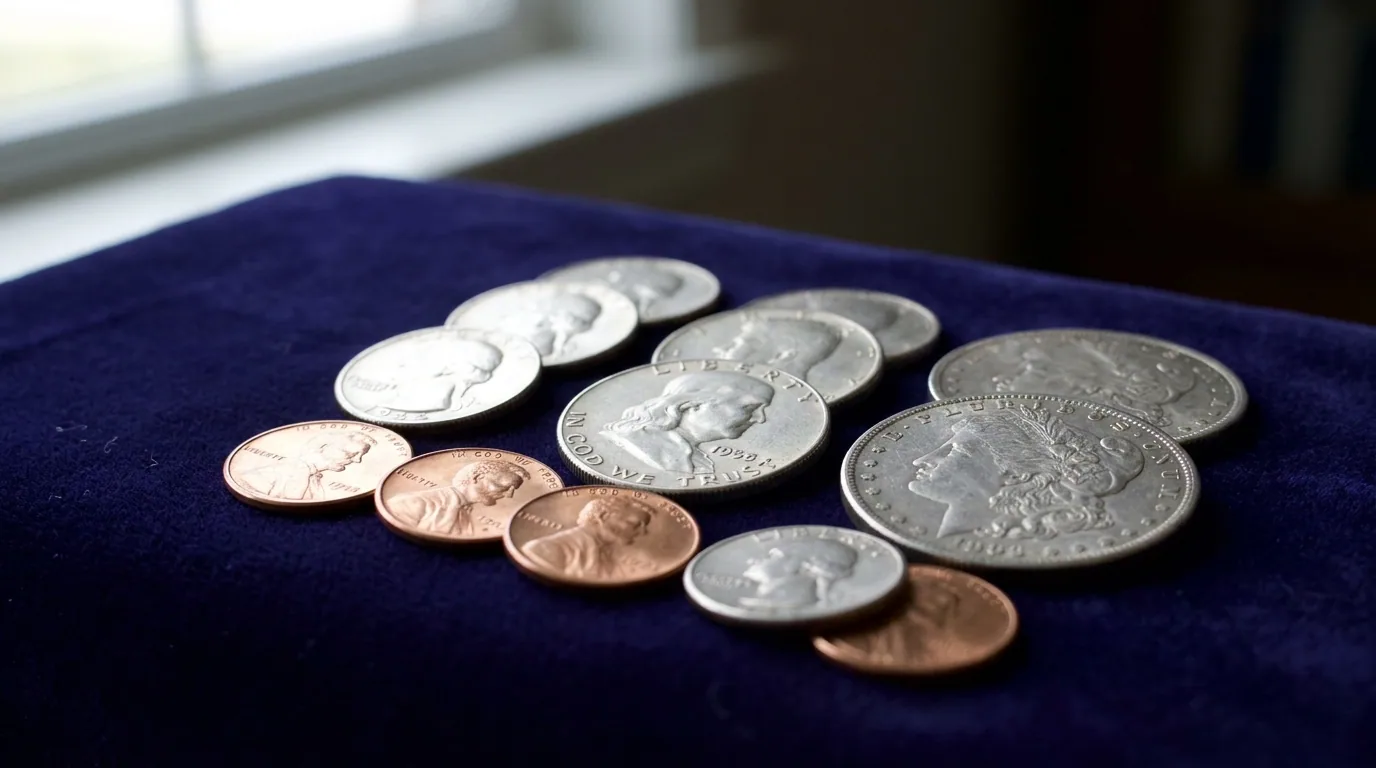
A 1969-S cent with doubling on the obverse has sold at auction for $126,500. Almost nothing in a change jar comes close: circulating coins trade at or near face value, and the cents in that jar are, with rare exceptions, worth a cent apiece, even now that the U.S. stopped making pennies in November 2025.
Ten coins with documented sale records follow, along with the quirk behind each price.
Four Things That Push a Coin Past Face Value
Age and low mintage limit how many exist at all. Mint errors, such as doubled dies, missing mint marks or the wrong reverse design, create tiny sub-populations that collectors chase.
Precious metal content sets a floor through melt value, which moves with the price of silver or gold. And condition multiplies all of it: the same coin can be worth a few dollars worn and thousands if it never circulated.
The auction figures below come from graded, certified examples, not from coins pulled loose out of a drawer.
The 1955 Doubled Die Penny Spent Years in Circulation
Auction record: $24,000.
The doubling on this cent is not subtle. Every letter and number on the obverse shows it.
What makes it interesting for anyone digging through old change is the history: many of these pennies circulated for years before collectors caught on, so worn examples still surface. Even at grades as low as MS55, they have sold for more than $2,000.
A 1969-S Doubled Die Penny Sold for $126,500
A few dozen of these are known, and that is scarcity enough to put an MS63 above $50,000; the record sale was an MS64.
The doubling itself covers the letters and numbers on the obverse but skips the S mint mark, which was punched on in a separate step.
The 1992-D "Close AM" Penny and the Wrong Reverse Design
Auction record: $14,100.
Billions of cents were struck in 1992, and roughly a dozen are known with this variety. On the reverse, the A and M in "AMERICA" sit almost touching, the result of the wrong reverse design being used.
Examples graded MS64 have sold for several thousand dollars, and the record belongs to an MS65.
Doubling on the 1972 Penny Shows Up in "Liberty" and the Date
Auction record: $14,400.
This is one of the easier errors to spot without magnification: the doubling is visible in "Liberty," in "In God We Trust," and in the date on the obverse. Sales above $1,000 have been recorded at MS66, with much higher prices in top grades.
The 1932-D Washington Quarter, at $143,750
Two factors stack up in this coin's favor. It was the first year of the George Washington portrait on the obverse, and it was produced during the Great Depression, so mintage was low compared with later years.
Finding one in strong condition is rare, and the record sale, an MS66, passed $143,000.
Silver Content in the 1964 Kennedy Half
Auction record: $57,600.
John F. Kennedy's portrait went onto the silver half dollar the year after his assassination. The 1964 coins were struck in 90% silver, and that was cut to 40% for the years that followed. Because so many were made, real money generally shows up only at MS67 and above. The record was set by an MS68.
A Few Hundred "Cheerios" Sacagawea Dollars Show Detailed Tail Feathers
Auction record: $33,600.
General Mills put more than 5,000 Sacagawea dollars into Cheerios boxes at random in 1999.
A few hundred of them show small markings in the tail feathers of the eagle on the reverse, and that detail is what separates them from the rest. Graded MS66 or better, they sell in the thousands; the record was an MS69.
The 1990 Proof Penny Missing Its S Mint Mark
Auction record: $20,700.
Proof coins are made for collectors, not for pocket change, so this one is far likelier to turn up in an inherited collection than in a coin cup.
Only about 200 are known, each missing the S mint mark on the obverse, and they sell for thousands even in lower grades. The record was a PR69.
The 1996 Silver Eagle Has the Lowest Mintage in the Series
Auction record: $21,850.
Silver coins can clear face value on melt value alone, based on the going rate for silver. The 1996 issue adds scarcity: just over 3.6 million were struck, the smallest run in the series. Prices at this level require a near-flawless coin, and the record was an MS70.
Gold Content and the 2009 High Relief Double Eagle
Auction record: $14,666.
Each $20 piece carries 31.1 grams of gold at 99.99% purity, struck in high relief, which is what gives the coins their sharp detail and satiny surface. The design is older than the coin: a rare Saint-Gaudens pattern from 1907, revived for this issue.
They are usually stored carefully rather than handled, and they tend to change hands for a few thousand dollars on the resale market. Because so much of the price is metal, sellers look at the current melt value before listing one.
How Grade Separates a Few Dollars From Thousands
Look at how often the records above hinge on a grade: MS64 versus MS66, PR69, MS70. Mint State (MS) numbers describe uncirculated business-strike coins, and PR numbers describe proofs, with higher figures meaning fewer marks and better strike quality.
On the same variety, one or two points can be the difference between a modest sale and a headline one.
Take the 1955 cent again. Worn from years in circulation, it sits at the low end of the range, where documented sales have run above $2,000. A pristine example of the same variety is what produced the $24,000 record. The error is the same in both cases; the condition isn't.
This is why third-party grading services exist, and why auction records are quoted with a grade attached. Certification costs money and takes time, and the fee can eat a meaningful share of a lower-grade coin's value.
Cleaning a Coin Cuts Its Value
The common mistake, and the costly one, is polishing a promising find. Wiping, scrubbing or dipping a coin leaves hairline scratches and alters the surface, and graders note it: a cleaned coin generally sells for less than the same coin left dirty.
Altered mint marks and added doubling are known problems in this market as well, which is part of why buyers pay premiums for certified examples. Prices for metal-heavy coins also move with the underlying commodity rather than staying fixed.
Which of These Could Still Turn Up in Change
Only a few of these coins ever moved through cash registers in any number. The doubled die cents from 1955 and 1972, and to a lesser extent the 1992-D close AM, are the ones that actually circulated and could still be sitting in a jar; the 1955 in particular went unnoticed for years.
The 1932-D quarter and the 1964 Kennedy half circulated too, but their records depend on grades that pocket change almost never reaches. The 1990 no-S proof, the 1996 Silver Eagle, the 2009 Double Eagle and the Cheerios dollar were never really change to begin with.
They live in collections, boxes and safes, which is where they tend to be found. Which group a coin belongs to says a lot about what a realistic sale looks like.